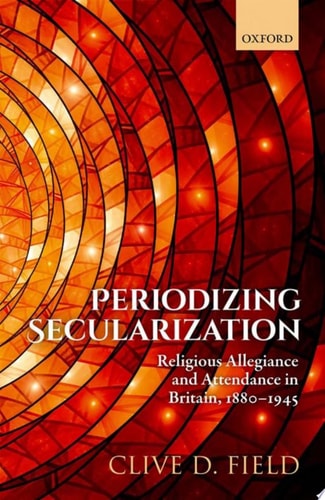
Periodizing Secularization: Religious Allegiance and Attendance in Britain, 1880-1945
0
0
As an Amazon Associate and affiliate partner, Menrva Books earns from qualifying purchases. Learn more
Author Description
Moving beyond the (now somewhat tired) debates about secularization as paradigm, theory, or master narrative, Periodizing Secularization focuses upon the empirical evidence for secularization, viewed in its descriptive sense as the waning social influence of religion, in Britain. Particular emphasis is attached to the two key performance indicators of religious allegiance and churchgoing, each subsuming several sub-indicators, between 1880 and 1945, including the first substantive account of secularization during the fin de siecle. A wide range of primary sources is deployed, many of them relatively or entirely unknown, and with due regard to their methodological and interpretative challenges. On the back of them, a cross-cutting statistical measure of 'active church adherence' is devised, which clearly shows how secularization has been a reality and a gradual, not revolutionary, process. The most likely causes of secularization were an incremental demise of a Sabbatarian culture (coupled with the associated emergence of new leisure opportunities and transport links) and of religious socialization (in the church, at home, and in the school). The analysis is also extended backwards, to include a summary of developments during the eighteenth and early nineteenth centuries; and laterally, to incorporate a preliminary evaluation of a six-dimensional model of 'diffusive religion', demonstrating that these alternative performance indicators have hitherto failed to prove that secularization has not occurred. The book is designed as a prequel to the author's previous volumes on the chronology of British secularization - Britain's Last Religious Revival? (2015) and Secularization in the Long 1960s (2017). Together, they offer a holistic picture of religious transformation in Britain during the key secularizing century of 1880-1980.
Menrva's Summary
THE THESIS
This book investigates the empirical evidence for secularization in Britain between 1880 and 1945, specifically examining the decline of religious allegiance and church attendance. Clive D. Field, a specialist in the history of religion, utilizes a vast array of primary sources to challenge existing theoretical debates. By constructing a cross-cutting statistical measure of 'active church adherence,' the author argues that secularization functioned as a gradual, incremental process rather than a sudden social shift. The work provides a rigorous methodological framework to assess the waning influence of religious institutions during the fin de siecle and beyond.
THE SCOPE MAP
What You Will Find
- Statistical analysis of religious allegiance and churchgoing trends from 1880 to 1945.
- A six-dimensional model evaluating the concept of 'diffusive religion' as an alternative indicator.
- Examination of primary source materials, including previously unknown archival data.
- Analysis of the decline of Sabbatarian culture and shifts in religious socialization within schools and homes.
THE AUTHORITY PERSPECTIVE
Experts recognize this work as a foundational quantitative study that provides necessary empirical depth to the broader secularization debate. Readers frequently note the academic density of the prose and the meticulous nature of the statistical methodology employed by the author.
Page Count:
336
Publication Date:
2019-12-31
Publisher:
Oxford University Press
ISBN-10:
0198848803
ISBN-13:
9780198848806
History
Religion
Great Britain
Secularization Theology
Secularization
Sociology
British History
Community Tags
Similar Books