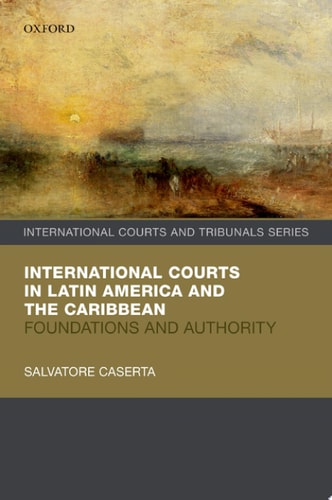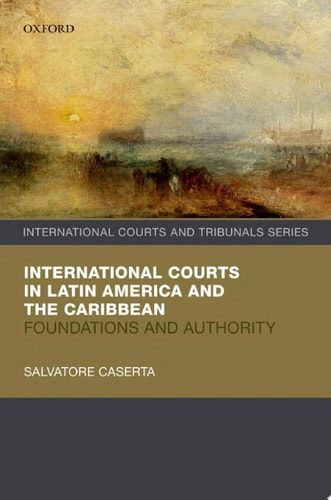
International Courts in Latin America and the Caribbean: Foundations and Authority
0
0
As an Amazon Associate and affiliate partner, Menrva Books earns from qualifying purchases. Learn more
Author Description
This book provides the first in-depth and empirically grounded analysis of the foundations and evolution of the four Latin American and Caribbean regional economic courts: the Central American Court of Justice (CACJ), the Caribbean Court of Justice (CCJ), the Andean Tribunal of Justice (ATJ), and the Mercosur Permanent Review Court (MPRC). While these Courts were established to build common markets and to enforce trade liberalisation, they have often developed bodies of jurisprudence in domains not directly associated with regional economic integration. The CCJ has been most successful in the area of human and fundamental rights; the CACJ has addressed issues related to the enforcement of the rule of law in national legal arenas and longstanding border disputes between the countries of the region; and the ATJ is an island of effective adjudication on intellectual property issues. The particular trajectories of these four Courts suggest that there is no universal formula for success. Challenging the mainstream account, this book argues that the Courts' operational path is not necessarily a function of their formally delegated competences or the will of the Member States. Rather, local socio-political contextual factors play a far more decisive role in influencing the direction of regional economic courts during and after their establishment.
Menrva's Summary
THE THESIS
This book investigates the factors that determine the operational success and jurisdictional evolution of regional economic courts in Latin America and the Caribbean. Salvatore Caserta, a scholar of international law and regional integration, utilizes a comparative empirical framework to challenge the conventional wisdom that formal legal mandates or state intent are the primary drivers of judicial development. Instead, the author argues that local socio-political contexts exert a more significant influence on how these institutions function and expand their authority beyond their original economic mandates.
THE SCOPE MAP
What You Will Find
- Comparative analysis of the Central American Court of Justice, the Caribbean Court of Justice, the Andean Tribunal of Justice, and the Mercosur Permanent Review Court.
- Empirical data regarding the evolution of jurisprudence in non-economic domains such as human rights and intellectual property.
- A theoretical framework linking regional institutional performance to local political and social environments.
Scope Limits
- The study does not provide an exhaustive legal history of every individual case handled by these courts.
- The analysis focuses primarily on regional economic courts and excludes broader international human rights bodies operating in the region.
THE AUTHORITY PERSPECTIVE
Experts identify this work as a significant contribution to the study of regional integration and international adjudication. Readers frequently note the academic density of the prose and the rigorous empirical methodology employed to evaluate institutional effectiveness.
Page Count:
314
Publication Date:
2020-01-01
Publisher:
OUP Oxford
ISBN-10:
0192638254
ISBN-13:
9780192638250
Economics
Human rights
American Studies
International relations
Professional Career & Trade
Law
Community Tags
Similar Books