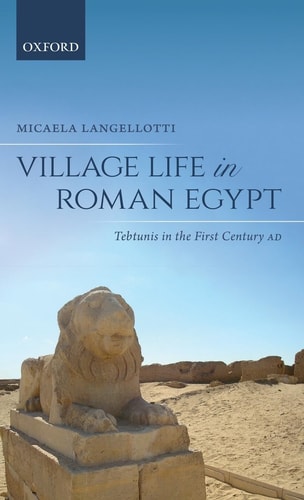
Village Life in Roman Egypt: Tebtunis in the First Century AD
0
0
As an Amazon Associate and affiliate partner, Menrva Books earns from qualifying purchases. Learn more
Author Description
This book presents the first detailed study of Tebtunis, a village in Egypt within the Roman Empire, in the first century AD. It is founded on the archive material of the local notarial office, or grapheion, which was run by a man named Kronion for most of the mid-first century. The archive, unparalleled in antiquity, includes over two hundred documents written on papyrus which attest a wide range of transactions made by the villagers over defined periods of time, in particular the years AD 42 and 45-7 under the reign of the emperor Claudius. This evidence provides a unique insight into various aspects of village life: the level of participation in the written contractual economy; the socio-economic stratification of the village, including the position of women, slaves, priests, and the role of the elite; the functions of associations; the types and importance of agriculture; and non-agricultural activities.This multitude of data reveals a highly diversified village economy, a large involvement in written transactions among all the strata of the population, and a rural society living mostly above subsistence level. Tebtunis provides a model of village society that can be used to understand the majority of the population within the Roman Empire who lived outside cities in the Mediterranean, particularly in the other eastern and more Hellenized provinces.
Menrva's Summary
THE THESIS
This book investigates the socio-economic structure and daily operations of the Egyptian village of Tebtunis during the first century AD. Micaela Langellotti, a scholar specializing in papyrology and Roman Egypt, utilizes the extensive archive of the local notarial office (grapheion) to reconstruct the lives of its inhabitants. By analyzing over two hundred papyrus documents from the reign of Emperor Claudius, the author challenges traditional assumptions about rural subsistence, arguing instead for a highly diversified and active contractual economy.
THE SCOPE MAP
What You Will Find
- Analysis of the Kronion archive, containing over two hundred primary source papyri from the mid-first century AD.
- Examination of socio-economic stratification, including the roles of women, slaves, priests, and local elites.
- Methodology for interpreting rural contractual economies and agricultural practices in the Roman Empire.
- Comparative framework for understanding non-urban populations across Hellenized Mediterranean provinces.
THE AUTHORITY PERSPECTIVE
Scholars recognize this work as a significant contribution to the study of Roman Egypt, particularly for its meticulous use of the grapheion archive to quantify rural economic activity. The text is noted for its academic rigor and is considered a foundational resource for researchers interested in the intersection of papyrology and social history.
Page Count:
320
Publication Date:
2020-03-04
Publisher:
Oxford University Press
ISBN-10:
0198835310
ISBN-13:
9780198835318
History
Economics
Africa - History
Archaeology
Social History
Egyptology
Ancient History
Community Tags
Similar Books