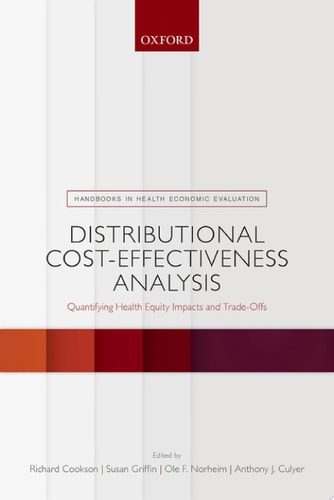
Distributional Cost-Effectiveness Analysis: Quantifying Health Equity Impacts and Trade-Offs
0
0
As an Amazon Associate and affiliate partner, Menrva Books earns from qualifying purchases. Learn more
Author Description
Distributional cost-effectiveness analysis aims to help health care and public health organisations make fairer decisions with better outcomes. Whereas standard cost-effectiveness analysis provides information about total costs and effects, distributional cost-effectiveness analysis provides additional information about fairness in the distribution of costs and effects - who gains, who loses, and by how much. It can also provide information about the trade-offs that sometimes occur between efficiency objectives, such as improving total health, and equity objectives, such as reducing unfair inequality in health.This is a practical guide to a flexible suite of economic methods for quantifying the equity consequences of health programmes in high-, middle- and low-income countries. The methods can be tailored and combined in various ways to provide useful information to different decision-makers in different countries with different distributional equity concerns. The handbook is primarily aimed at postgraduate students and analysts specialising in cost-effectiveness analysis but is also accessible to a broader audience of health sector academics, practitioners, managers, policymakers and stakeholders.As well as offering an overview for research commissioners, users, and producers, the book includes systematic technical guidance on how to simulate and evaluate distributions, with accompanying hands-on spreadsheet training exercises, and discussions about how to handle uncertainty about facts and disagreement about values, and the future challenges facing this young and rapidly evolving field of study.
Menrva's Summary
THE THESIS
This book investigates how distributional cost-effectiveness analysis (DCEA) can be utilized to quantify the health equity impacts of public health interventions and navigate the trade-offs between efficiency and fairness. The authors, a team of experts in health economics and ethics, provide a comprehensive framework for evaluating who benefits from health programs and who bears the costs. By integrating economic modeling with equity-focused metrics, the text offers a structured approach to decision-making that addresses both total health outcomes and the reduction of unfair health inequalities across diverse global contexts.
THE SCOPE MAP
What You Will Find
- Methodologies for simulating and evaluating the distribution of health costs and effects across different population groups.
- Technical guidance on applying DCEA in both high-income and low-income country settings.
- Practical spreadsheet training exercises designed to facilitate hands-on application of the economic models.
- Frameworks for managing uncertainty regarding empirical facts and navigating disagreements concerning societal values.
THE AUTHORITY PERSPECTIVE
Experts identify this handbook as a foundational resource for practitioners and students seeking to integrate equity considerations into standard economic evaluations. Readers frequently note the technical density of the prose, which serves as a rigorous guide for those tasked with complex policy analysis in the health sector.
Page Count:
384
Publication Date:
2020-11-30
Publisher:
Oxford University Press
ISBN-10:
0198838190
ISBN-13:
9780198838197
Economics
Social Science
Health Policy
Public Health
Statistics
Community Tags
Similar Books