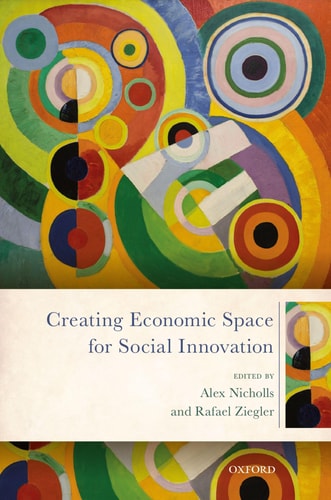
Creating Economic Space for Social Innovation
0
0
As an Amazon Associate and affiliate partner, Menrva Books earns from qualifying purchases. Learn more
Author Description
This book draws upon economic and sociological theory to provide a comprehensive discussion of economic space for social innovation, addressing especially marginalized groups and the long-term projects, programmes, and policies that have emerged and evolved within and across European states. It approaches the explanatory and normative questions raised by this topic via a novel approach: the Extended Social Grid Model (ESGM). Taking inspiration from the fields of economic sociology and ethics, this model shows that social innovation processes must be structural, and require change in power relations, if marginalization is to be effectively dealt with via social innovation.Part I of the book sets out the ESGM, including an exposition on the model along with background chapters on innovation, power and marginalization, ethics and social innovation, and empirical methods. Part II explores the model with a focus on social innovation trajectories of social housing, drinking water provision, employment, education, and food provision. It also explores the operationalization of the model with a view to agency and empowerment, as well as social innovation policy in Europe and the use of social impact bonds as a tool for financing social innovation. Part III revisits the ESGM and considers the explanatory adequacy and fruitfulness of the model for innovation research and for theorizing social innovation, addressing questions on the role and limitations of participation in social innovation for the marginalized, the role of capital for creating economic space for capabilities, and how we can approach the social impact of social innovation.This collection of essays presents a diverse range of perspectives on understanding and addressing the key issue of marginalization, and offers key recommendations for policy makers engaging with social innovation across the European Union and beyond.
Menrva's Summary
THE THESIS
This book investigates how economic and sociological frameworks can be utilized to create viable economic space for social innovation aimed at addressing systemic marginalization. Nicholls introduces the Extended Social Grid Model (ESGM), a theoretical construct designed to analyze the structural power relations that inhibit social progress. By synthesizing insights from economic sociology and ethics, the author provides a rigorous methodology for evaluating how long-term projects and policies can effectively empower marginalized populations across European states.
THE SCOPE MAP
What You Will Find
- The Extended Social Grid Model (ESGM) as a primary analytical framework for social innovation.
- Empirical analysis of social housing, water provision, employment, education, and food security sectors.
- Evaluation of policy instruments including social impact bonds and their role in financing social change.
- Theoretical exploration of the limitations of participation and the role of capital in expanding capabilities.
THE AUTHORITY PERSPECTIVE
Experts identify this work as a significant contribution to the intersection of economic theory and social policy. Readers frequently note the academic density of the prose, which serves as a foundational text for researchers and policymakers interested in structural social change.
Page Count:
471
Publication Date:
2020-02-18
Publisher:
Oxford
ISBN-10:
0198830513
ISBN-13:
9780198830511
Economics
Social change
Sociology
Innovation
Social Science
Public Policy
Europe
Community Tags
Similar Books