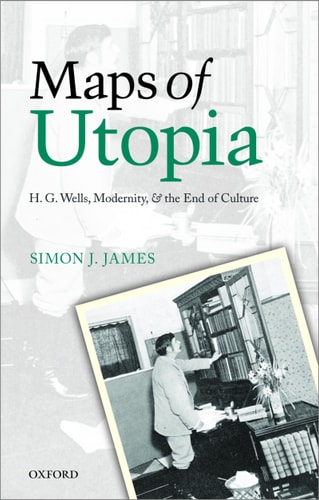
Maps of Utopia: H. G. Wells, Modernity, and the End of Culture
0
0
As an Amazon Associate and affiliate partner, Menrva Books earns from qualifying purchases. Learn more
Author Description
H. G. Wells is one of the most widely-read writers of the twentieth century, but until now the aesthetics of his work have not been investigated in detail. Maps of Utopia tells the story of Wells's writing career over six decades, during which he produced popular science, educational theory, history, politics, prophecy, and utopia, as well as realist, experimental, and science fiction. This book asks what Wells thought literature was, and what he thought it was for. H. G. Wells formulated a literary aesthetics based on scientific principles, designed to improve the world both in the present and for future generations. Unlike Henry James, with whom he famously argued, Wells was not content simply to let literary art be, for its own sake: he wanted to make art instrumental in improving the lives of its readers, by bringing about the founding the World State that he predicted was man's only alternative to self-destruction. Such a project differed radically from the aims of Wells's late-Victorian and his Modernist contemporaries with consequences for the nature both of Wells's writing and for his subsequent critical reception. Maps of Utopia begins with the late-Victorian debate about the uses of effect of reading, especially reading fiction, that followed the mass literacy of the 1870-71 Education Acts. It considers Wells's best known scientific romances, such as The Time Machine and The War of the Worlds, and important social novels such as Tono-Bungay. It also examines less well-known texts such as The Sea Lady, Boon and Wells's journalism and political writings. This study closes with his cinematic collaboration The Shape of Things to Come, and The Outline of History, Wells's best-selling book in his own lifetime.
Menrva's Summary
THE THESIS
This study investigates the literary aesthetics of H. G. Wells, questioning how his scientific principles and social objectives shaped his diverse body of work. Simon J. James, an expert in late-Victorian and Edwardian literature, examines how Wells rejected the 'art for art's sake' movement in favor of a utilitarian approach to writing. By analyzing Wells's career across six decades, James argues that the author viewed literature as a vital instrument for social reform and the establishment of a global World State.
THE SCOPE MAP
What You Will Find
- Analysis of Wells's literary evolution from scientific romances to political and historical treatises.
- Examination of the tension between Wells's instrumentalist aesthetics and the prevailing Modernist literary standards.
- Discussion of the impact of the 1870-71 Education Acts on the production and reception of popular fiction.
- Detailed case studies of major works including The Time Machine, The War of the Worlds, Tono-Bungay, and The Outline of History.
THE AUTHORITY PERSPECTIVE
Scholars recognize this work as a significant contribution to the study of Wells, particularly for its focus on his often-overlooked aesthetic theories. Readers frequently note the academic density of the prose, which provides a rigorous framework for understanding the intersection of Wells's political vision and his narrative techniques.
Page Count:
248
Publication Date:
2020-04-02
Publisher:
Oxford University Press
ISBN-10:
0198833776
ISBN-13:
9780198833772
History
Science Fiction
Biography
Modernism
Literary Criticism
Community Tags
Similar Books