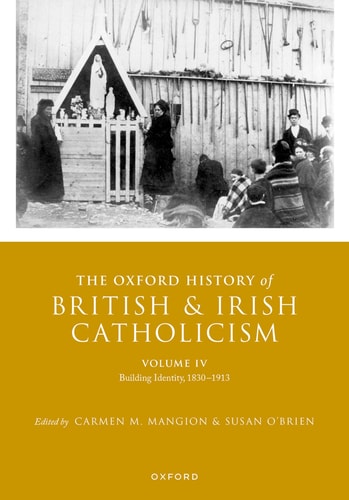
The Oxford History of British and Irish Catholicism, Volume IV: Building Identity, 1830-1913
0
0
As an Amazon Associate and affiliate partner, Menrva Books earns from qualifying purchases. Learn more
Author Description
After 1830 Catholicism in Britain and Ireland was practised and experienced within an increasingly secure Church that was able to build a national presence and public identity. With the passage of the Catholic Relief Act (Catholic Emancipation) in 1829 came civil rights for the United Kingdom's Catholics, which in turn gave Catholic organisations the opportunity to carve out a place in civil society within Britain and its empire. This Catholic revival saw both a strengthening of central authority structures in Rome, (creating a more unified transnational spiritual empire with the person of the Pope as its centre), and a reinvigoration at the local and popular level through intensified sacramental, devotional, and communal practices. After the 1840s, Catholics in Britain and Ireland not only had much in common as a consequence of the Church's global drive for renewal, but the development of a shared Catholic culture across the two islands was deepened by the large-scale migration from Ireland to many parts of Britain following the Great Famine of 1845. Yet at the same time as this push towards a degree of unity and uniformity occurred, there were forces which powerfully differentiated Catholicism on either side of the Irish Sea. Four very different religious configurations of religious majorities and minorities had evolved since the sixteenth-century Reformation in England, Ireland, Scotland, and Wales. Each had its own dynamic of faith and national identity and Catholicism had played a vital role in all of them, either as 'other' or, (in the case of Ireland), as the majority's 'self'. Identities of religion, nation, and empire, and the intersection between them, lie at the heart of this volume. They are unpacked in detail in thematic chapters which explore the shared Catholic identity that was built between 1830 and 1913 and the ways in which that identity was differentiated by social class, gender and, above all, nation. Taken together, these chapters show how Cath
Menrva's Summary
THE THESIS
This volume investigates how British and Irish Catholicism constructed a distinct public identity and national presence between 1830 and 1913. The authors, Carmen M. Mangion and Susan O'Brien, utilize historical analysis to examine the intersection of religion, national identity, and imperial influence following the Catholic Relief Act of 1829. By synthesizing archival research and thematic studies, the text argues that while global church renewal fostered a unified spiritual culture, local socio-political dynamics and migration patterns simultaneously drove significant differentiation across the British Isles.
THE SCOPE MAP
What You Will Find
- Analysis of the impact of the 1829 Catholic Relief Act on civil society and organizational development.
- Examination of the influence of the Great Famine on migration and the subsequent cross-island Catholic culture.
- Comparative study of religious configurations in England, Ireland, Scotland, and Wales.
- Exploration of how social class, gender, and national identity shaped the lived experience of the faith.
THE AUTHORITY PERSPECTIVE
Scholars and historians recognize this volume as a critical contribution to the study of nineteenth-century religious history. Readers frequently note the academic density of the prose and the depth of the thematic chapters in unpacking complex intersections of identity.
Page Count:
368
Publication Date:
2024-01-01
Publisher:
Oxford University Press
ISBN-10:
0198848196
ISBN-13:
9780198848196
History
Religion
Great Britain
Sociology of Religion
Irish History
Catholicism
British History
Community Tags
Similar Books





Reader Comments
Share Your Thoughts
No comments yet. Be the first to share your thoughts!