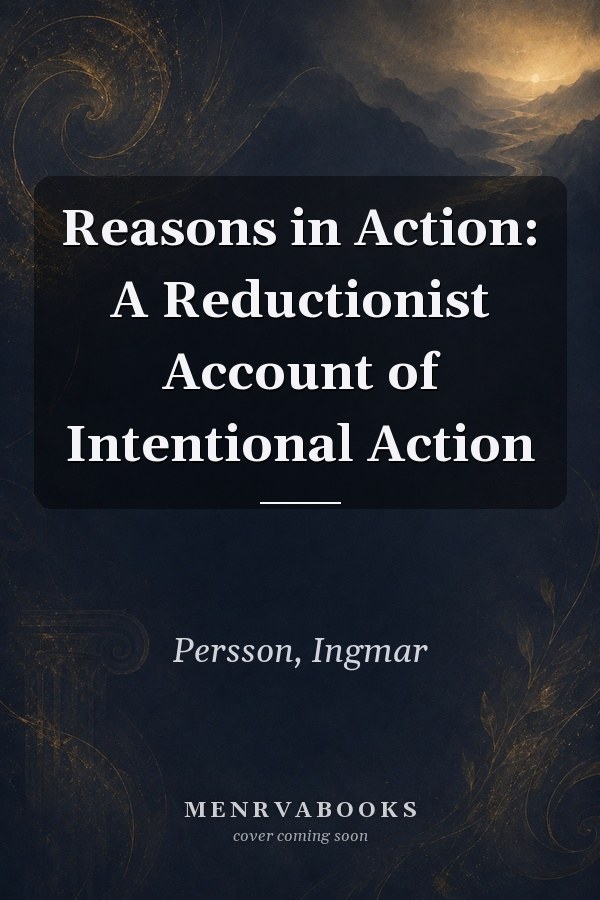
Reasons in Action: A Reductionist Account of Intentional Action
0
0
As an Amazon Associate and affiliate partner, Menrva Books earns from qualifying purchases. Learn more
Author Description
Ingmar Persson offers an original view of the processes of human action: deliberating on the basis of reasons for and against actions, making a decision about what to do, and from there implementing the decision in action in a way that makes the action intentional. Persson's analysis is mainly developed to suit physical actions, though how it needs to be modified to cover mental acts is also discussed. The interpretation of intentional action that is presented is reductionist in the sense that it does not appeal to any concepts that are distinctive of the domain of action theory, such as a unique type of agent-causation, or irreducible mental acts, like acts of will, volitions, decisions, or tryings. Nor does it appeal to any unanalyzed attitudes or states essentially related to intentional action, like intentions and desires to act. Instead, the intentionality of actions is construed as springing from desires conceived as physical states of agents which cause facts because of the way agents think of them. A sense of our having responsibility that is sufficient for our acting for reasons is also sketched out.
Menrva's Summary
THE THESIS
This work investigates whether intentional human action can be explained through a reductionist framework that avoids irreducible mental states or agent-causation. Ingmar Persson, a philosopher specializing in ethics and action theory, constructs a model where intentionality emerges from physical states. By analyzing the sequence of deliberation, decision-making, and implementation, he argues that actions are grounded in physical desires and cognitive processes rather than mysterious volitions or unanalyzed mental acts. The text provides a rigorous logical structure to support this physicalist interpretation of agency.
THE SCOPE MAP
What You Will Find
- A reductionist analysis of the deliberation and decision-making process.
- A framework for distinguishing between physical actions and mental acts.
- An argument against the necessity of agent-causation and irreducible volitions.
- A conceptual sketch regarding the nature of moral responsibility in an action-theoretic context.
THE AUTHORITY PERSPECTIVE
Experts in philosophy of mind and action theory recognize this text as a significant contribution to the debate surrounding physicalist accounts of agency. Readers frequently note the technical density of the prose, which requires a strong background in analytic philosophy to navigate effectively.
Page Count:
192
Publication Date:
2019-11-05
Publisher:
Oxford University Press
ISBN-10:
0198845030
ISBN-13:
9780198845034
Philosophy
Intentionalism
Reason
Action theory
Act Philosophy
Metaphysics
Community Tags
Other Editions(2)
Similar Books