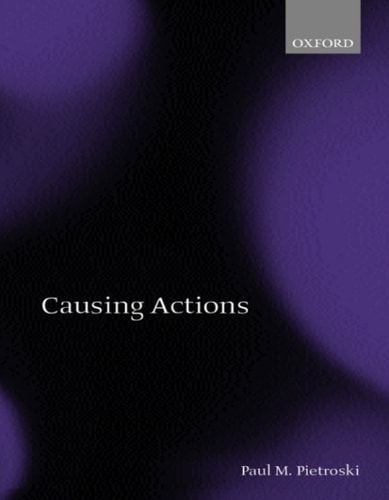
Causing Actions
0
0
As an Amazon Associate and affiliate partner, Menrva Books earns from qualifying purchases. Learn more
Author Description
Thoughts often cause deeds. Actions are done for reasons. But do actions and their mental causes also have descriptions that do not involve reasons? Various considerations can make it seem that human mental events must be biochemical events. Paul Pietroski, however, defends a non-Cartesian form of dualism. Actions and their rationalizing causes belong to an autonomous mental domain-although this autonomy is compatible with the supervenience of the mental on the non-mental. On this view, some bodily motions have rationalizing causes distinct from any biochemical causes; Pietroski argues that this is not an objectionable form of overdetermination. Central to his account is his proposed treatment of ceteris paribus laws, their role in explanation, and how such laws are related to singular causal claims. Pietroski also connects these issues to semantic questions arising from discussions of action reports and belief ascriptions. All philosophers interested in mind or causation will be intrigued by his new theory.
Menrva's Summary
THE THESIS
This book investigates whether human actions and their mental causes can be described independently of biochemical processes while maintaining a coherent framework for rational explanation. Paul M. Pietroski, a philosopher specializing in the philosophy of mind and language, constructs an argument for a non-Cartesian form of dualism. He posits that actions and their rationalizing causes exist within an autonomous mental domain, arguing that this autonomy remains compatible with the supervenience of the mental on the physical. By addressing the nature of ceteris paribus laws and their role in causal explanation, he seeks to resolve the problem of overdetermination in human behavior.
THE SCOPE MAP
What You Will Find
- A defense of non-Cartesian dualism regarding mental events and bodily motions.
- An analysis of ceteris paribus laws and their application to singular causal claims.
- A discussion on the semantics of action reports and belief ascriptions.
Scope Limits
- The text does not provide a comprehensive survey of all contemporary physicalist theories.
- It does not focus on neurobiological data, but rather on the conceptual and logical structure of causal explanation.
THE AUTHORITY PERSPECTIVE
Philosophers and scholars in the field of action theory frequently cite this work for its rigorous approach to the intersection of mental causation and semantic theory. Readers often note the high level of academic density, requiring a strong background in analytic philosophy to fully engage with the author's logical framework.
Page Count:
288
Publication Date:
2000-01-01
Publisher:
Oxford University Press
ISBN-10:
0191520233
ISBN-13:
9780191520235
Philosophy
Causation
Philosophy of
Metaphysics
Act Philosophy
Action theory
Community Tags
Similar Books