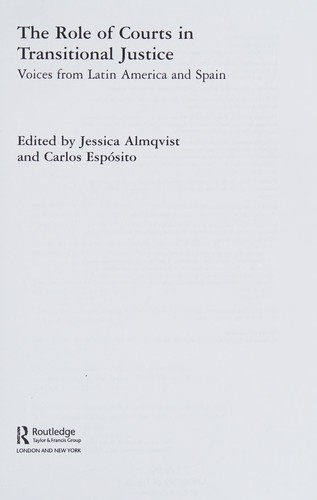
The Role of Courts in Transitional Justice
0
0
As an Amazon Associate and affiliate partner, Menrva Books earns from qualifying purchases. Learn more
Author Description
This book examines the role of courts in times of transition. The book focuses on judicial experiences from the Iberoamerican region, in particular Argentina, Chile, Colombia, Spain and Guatemala, exploring the extent to which national courts have been able to shoulder the task of investigating and prosecuting grave crimes such as genocide, crimes against humanity and war crimes, committed in the context of a previous repressive rule or current conflict. The volume contains contributions from judges, prosecutors, and scholarly experts in the region. It offers first-hand experiences and expert findings on crucial issues surrounding the role of the courts including: balancing principles of justice and fundamental concerns about legality and non-retroactivity; security problems facing courts in conflict situations; the immense case load; the role of regional and international courts in aiding their national counterparts; and the cooperation between different and overlapping jurisdictional competences. The book also draws attention to the way in which regional and international courts have come to contribute to the initiation of national judicial processes, above all, through international standard-setting and pressure. It goes on to articulate a philosophical critique of the dominant understandings of transitional justice because it has not paid sufficient attention to criminal justice. In this context, the volume outlines an alternative conceptualisation that seems better equipped to both explain the recent developments towards the 'judicialization' of transitional justice politics while, at the same time, also insisting on the continued need for caution and critical reflection on the role of courts in times of transition
Menrva's Summary
THE THESIS
This book investigates the critical and often contentious role of national courts in societies undergoing significant political and social upheaval. It examines the capacity of judicial systems in the Iberoamerican region, specifically Argentina, Chile, Colombia, Spain, and Guatemala, to prosecute grave crimes such as genocide, crimes against humanity, and war crimes. The volume compiles insights from judges, prosecutors, and academic experts, offering a multi-faceted perspective on the challenges and successes of judicialization in transitional contexts, including issues of legality, security, case management, and the influence of regional and international legal bodies.
THE SCOPE MAP
- Analysis of judicial experiences in Argentina, Chile, Colombia, Spain, and Guatemala.
- Exploration of the prosecution of genocide, crimes against humanity, and war crimes.
- Contributions from judges, prosecutors, and scholarly experts.
- Discussion of balancing justice principles with legality and non-retroactivity.
- Examination of security challenges faced by courts in conflict situations.
- Assessment of the impact of regional and international courts on national processes.
- Critique of dominant transitional justice understandings for their neglect of criminal justice.
- Presentation of an alternative conceptualization of transitional justice emphasizing criminal justice.
THE AUTHORITY PERSPECTIVE
This volume is regarded as a significant contribution to the field of transitional justice, particularly for its focus on the practical experiences and challenges faced by national judiciaries. The inclusion of perspectives from practitioners within the Iberoamerican region offers a grounded and nuanced understanding of judicial processes during periods of transition. The book is noted for its critical engagement with existing transitional justice frameworks, advocating for a stronger emphasis on criminal justice mechanisms. Its analysis of the 'judicialization' of transitional justice, while acknowledging its advancements, also calls for continued critical reflection on the role of courts.
Page Count:
0
Publication Date:
2011-01-01
ISBN-10:
0415601371
ISBN-13:
9780415601375
Non-Fiction
Politics
History
Human rights
International Law
Latin America
Transitional Justice
Community Tags
Similar Books