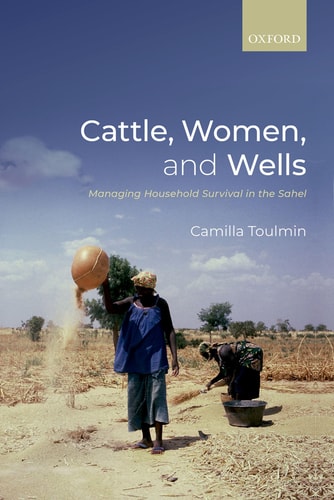
Cattle, Women, and Wells: Managing Household Survival in the Sahel
0
0
As an Amazon Associate and affiliate partner, Menrva Books earns from qualifying purchases. Learn more
Author Description
How people adapt and survive in the harsh environment of the drought-prone Sahelian region to the south of the Saharan desert forms the subject of this book.The author concentrates on the choices facing farmers in a small village in central Mali, West Africa. These farmers have had continually to adapt their farming methods in order to survive. The study shows how such changes have taken place and why some families are more successful than others in surviving and prospering. It provides an analysis of millet yields, and of returns to investment in ploughs, wells, and breeding cattle. Decisions regarding marriage, child-rearing, and household organization are discussed within an economic framework to demonstrate the strong economic rationale behind choices made in these spheres.The book concludes that larger, more diverse households found within this society (containing as many as forty to sixty people) are much better able to resist the risks of drought and illness than are small nuclear family groups. Environmental issues are shown to be crucial to the longer term viability of such a community.
Menrva's Summary
THE THESIS
This book investigates the economic and social strategies employed by rural households in the Sahel to mitigate the risks of drought and environmental instability. Camilla Toulmin, an expert in African development and agricultural economics, utilizes longitudinal data from a village in central Mali to analyze how household structure and resource management influence long-term survival. The work argues that larger, multi-generational household units provide a superior economic buffer against environmental volatility compared to smaller nuclear family models.
THE SCOPE MAP
What You Will Find
- Analysis of agricultural productivity including millet yields and investment returns on farming equipment.
- Examination of household organizational structures and their impact on risk management.
- Evaluation of social and demographic decisions, such as marriage and child-rearing, through an economic lens.
- Assessment of environmental factors and their influence on community viability in the Sahelian region.
THE AUTHORITY PERSPECTIVE
Experts in development studies and African anthropology frequently cite this work as a foundational case study for understanding rural household economics in arid environments. Readers often note the rigorous integration of quantitative agricultural data with qualitative social analysis, making it a standard reference for those studying resilience in the Sahel.
Page Count:
320
Publication Date:
2020-09-01
Publisher:
Oxford University Press
ISBN-10:
0198853041
ISBN-13:
9780198853046
Economics
Anthropology
Human ecology
Africa
Agriculture
Africa - History
Sociology
Mali
Community Tags
Similar Books