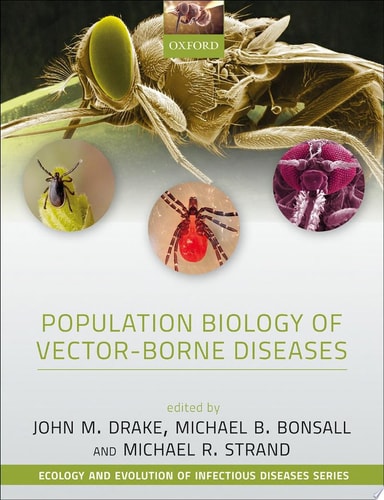
Population Biology of Vector-Borne Diseases
0
0
As an Amazon Associate and affiliate partner, Menrva Books earns from qualifying purchases. Learn more
Author Description
Population Biology of Vector-Borne Diseases is the first comprehensive survey of this rapidly developing field. The chapter topics provide an up-to-date presentation of classical concepts, reviews of emerging trends, synthesis of existing knowledge, and a prospective agenda for future research. The contributions offer authoritative and international perspectives from leading thinkers in the field. The dynamics of vector-borne diseases are far more intrinsically ecological compared with their directly transmitted equivalents. The environmental dependence of ectotherm vectors means that vector-borne pathogens are acutely sensitive to changing environmental conditions. Although perennially important vector-borne diseases such as malaria and dengue have deeply informed our understanding of vector-borne diseases, recent emerging viruses such as West Nile virus, Chikungunya virus, and Zika virus have generated new scientific questions and practical problems. The study of vector-borne disease has been a particularly rich source of ecological questions, while ecological theory has provided the conceptual tools for thinking about their evolution, transmission, and spatial extent.Population Biology of Vector-Borne Diseases is an advanced textbook suitable for graduate level students taking courses in vector biology, population ecology, evolutionary ecology, disease ecology, medical entomology, viral ecology/evolution, and parasitology, as well as providing a key reference for researchers across these fields.
Menrva's Summary
THE THESIS
This text investigates the complex ecological and evolutionary dynamics that govern the transmission and persistence of vector-borne diseases. The authors, John M. Drake, Michael Bonsall, and Michael Strand, synthesize classical epidemiological concepts with contemporary research to address how environmental factors influence pathogen spread. By integrating ecological theory with field-specific data, the book establishes a rigorous framework for understanding the sensitivity of ectotherm vectors to changing global conditions.
THE SCOPE MAP
What You Will Find
- Comprehensive analysis of vector-borne disease dynamics compared to directly transmitted pathogens.
- Examination of emerging viral threats including West Nile, Chikungunya, and Zika viruses.
- Theoretical frameworks for modeling disease evolution, transmission, and spatial distribution.
- Synthesis of ecological principles applied to medical entomology and parasitology.
THE AUTHORITY PERSPECTIVE
Experts identify this work as a foundational text for graduate-level study in disease ecology and vector biology. Readers frequently note the academic density of the prose, which serves as a primary reference for researchers navigating the intersection of ecology and infectious disease.
Page Count:
304
Publication Date:
2020-09-15
Publisher:
Oxford University Press
ISBN-10:
0198853246
ISBN-13:
9780198853244
Science
Ecology
Biology
Evolutionary Biology
Epidemiology
Entomology
Community Tags
Other Editions(3)
Similar Books












Reader Comments
Share Your Thoughts
No comments yet. Be the first to share your thoughts!