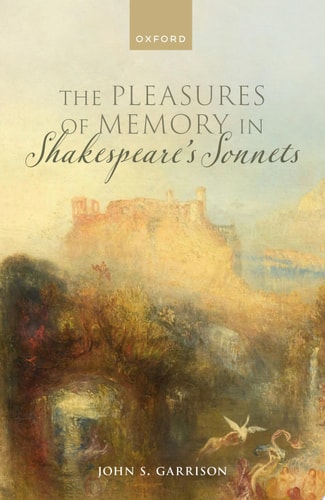
The Pleasures of Memory in Shakespeare's Sonnets
Author Description
The Pleasures of Memory in Shakespeare's Sonnets uses Shakespeare's poetry as a case study for the mutually formative relationship between desire and recollection. Through a series of close readings that are both historically situated and informed by recent theory, it traces how the speaker of the poems strives for a more agential relationship to his own memory by treating recollection as a form of narrative.Drawing together insights from cognitive science, the early modern memory arts, and psychoanalysis, John S. Garrison connects the Sonnets to the larger Renaissance project of conceiving memory as a faculty to be developed and managed through self-discipline and rhetoric. In doing so, he reveals how early modern thought presaged many theories that have emerged in contemporary neuroscientific and psychoanalytic understandings of the self and its longing for pleasure. The Sonnets emerge as a collection that contemplates the affective dimensions and conceptual overlaps that bind anticipation to retrospection in the fraught pursuit of erotic pleasure.Indispensable for students and scholars working on Shakespeare's poetry, this study appeals also to a broader audience of readers interested in affect, memory, and sexuality studies. Shakespeare's most beloved sonnets are discussed, as well as less familiar ones, alongside contemporary adaptations of the poems. Garrison brings the Sonnets further into the present by comparing them with treatments of pleasure and memory by modern authors such as C.P. Cavafy, Toni Morrison, William Faulkner, and Michael Ondaatje.
Menrva's Summary
THE THESIS
This book investigates the intersection of desire and recollection in Shakespeare's Sonnets, arguing that the speaker utilizes memory as a narrative tool to manage erotic longing. John S. Garrison, a scholar of early modern literature, synthesizes historical memory arts with contemporary cognitive science and psychoanalytic theory. He posits that the Sonnets reflect a Renaissance preoccupation with self-discipline, where memory is treated as a faculty that can be actively shaped and directed to achieve emotional and erotic ends.
THE SCOPE MAP
What You Will Find
- Close readings of both canonical and lesser-known Shakespearean sonnets.
- An interdisciplinary framework connecting early modern rhetoric to modern neuroscientific theories of the self.
- Comparative analysis between Shakespeare and modern authors including C.P. Cavafy, Toni Morrison, William Faulkner, and Michael Ondaatje.
- Examination of the affective dimensions that link anticipation to retrospection in the pursuit of pleasure.
THE AUTHORITY PERSPECTIVE
Scholars and students of early modern literature identify this work as a significant contribution to the study of affect and memory in Shakespearean verse. Readers frequently note the academic density of the prose, which effectively bridges the gap between historical literary analysis and contemporary psychological theory.
Page Count:
208
Publication Date:
2024-01-01
Publisher:
Oxford University Press
ISBN-10:
0198857713
ISBN-13:
9780198857716
Poetry
Shakespeare Studies
Poetry
Psychoanalysis
Literary Criticism
Community Tags
Similar Books