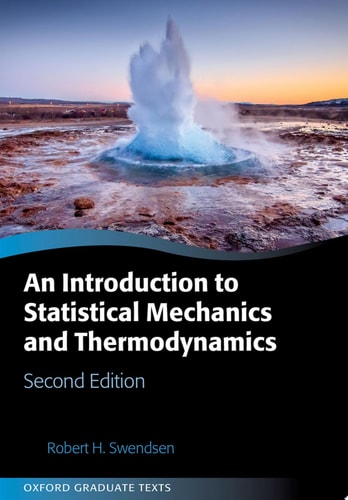
An Introduction to Statistical Mechanics and Thermodynamics
0
0
As an Amazon Associate and affiliate partner, Menrva Books earns from qualifying purchases. Learn more
Author Description
An Introduction to Statistical Mechanics and Thermodynamics returns with a second edition which includes new chapters, further explorations, and updated information into the study of statistical mechanics and thermal dynamics.The first part of the book derives the entropy of the classical ideal gas, using only classical statistical mechanics and an analysis of multiple systems first suggested by Boltzmann. The properties of the entropy are then expressed as "postulates" of thermodynamics in the second part of the book. From these postulates, the formal structure of thermodynamics is developed.The third part of the book introduces the canonical and grand canonical ensembles, which are shown to facilitate calculations for many model systems. An explanation of irreversible phenomena that is consistent with time-reversal invariance in a closed system is presented.The fourth part of the book is devoted to quantum statistical mechanics, including black-body radiation, the harmonic solid, Bose-Einstein and Fermi-Dirac statistics, and an introduction to band theory, including metals, insulators, and semiconductors. The final chapter gives a brief introduction to the theory of phase transitions.Throughout the book, there is a strong emphasis on computational methods to make abstract concepts more concrete.
Menrva's Summary
THE THESIS
This text investigates the foundational principles of statistical mechanics and thermodynamics by bridging the gap between microscopic particle behavior and macroscopic thermal properties. Professor Robert H. Swendsen utilizes a pedagogical approach that prioritizes the derivation of entropy from classical statistical mechanics before formalizing the laws of thermodynamics. The work provides a rigorous framework for understanding complex systems, integrating computational methods to clarify abstract physical concepts for graduate-level students.
THE SCOPE MAP
What You Will Find
- Derivation of entropy for classical ideal gases using Boltzmann-inspired analysis
- Formal development of thermodynamic postulates and structures
- Application of canonical and grand canonical ensembles to model systems
- Analysis of quantum statistical mechanics including Bose-Einstein and Fermi-Dirac statistics
- Examination of irreversible phenomena and phase transitions
THE AUTHORITY PERSPECTIVE
Experts and students frequently cite this text for its clear, logical progression from classical foundations to quantum applications. The inclusion of computational methods is widely regarded as a significant aid for those attempting to visualize complex statistical models.
Page Count:
496
Publication Date:
2020-02-10
Publisher:
Oxford University Press
ISBN-10:
0198853238
ISBN-13:
9780198853237
Science
Physics
Thermodynamics
Categories
Mechanics
Statistical mechanics
Kindle eBooks
Mathematical Physics
Solid-State Physics
Kindle Store
Earth Sciences
Textbooks
Dynamics
Community Tags
Similar Books