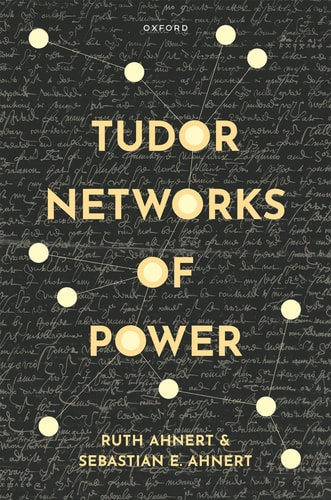
Tudor Networks of Power
0
0
As an Amazon Associate and affiliate partner, Menrva Books earns from qualifying purchases. Learn more
Author Description
Tudor Networks of Power is the product of a groundbreaking collaboration between an early modern book historian and a physicist specializing in complex networks. Together they have reconstructed and computationally analysed the networks of intelligence, diplomacy, and political influence across a century of Tudor history (1509-1603), based on the British State Papers.The 130,000 letters that survive in the State Papers from the Tudor period provide crucial information about the textual organization of the social network centred on the Tudor government. Whole libraries have been written using this archive, but until now nobody has had access to the macroscopic tools that allow us to ask questions such as: What are the reasons for the structure of the Tudor government's intelligence network? What was it geographical reach and coverage? Can we use network data to show patterns of surveillance? What role did women play in these government networks? And what biases are there in the data?The authors employ methods from the field of network science, translating key concepts and approaches into a language accessible to literary scholars and historians, and illustrating them with examples drawn from this fantastically rich archive. Each chapter is the product of a set of thematically organized 'experiments', which show how particular methods can help to ask and answer research questions specific to the State Papers archive, but also have applications for other large bodies of humanities data. The fundamental aim of this book, therefore, is not merely to provide an innovative perspective on Tudor politics; it also aspires to introduce an entirely new audience to the methods and applications of network science, and to suggest the suitability of these methods for a range of humanistic inquiry.
Menrva's Summary
THE THESIS
How can the application of network science to the British State Papers reveal the hidden structures of intelligence, diplomacy, and political influence in Tudor England? Dr. Sebastian E. Ahnert, a physicist, and Professor Ruth Ahnert, a book historian, combine their expertise to analyze 130,000 surviving letters from the period between 1509 and 1603. By translating complex network theory into a framework accessible to humanities scholars, the authors demonstrate how computational methods can uncover patterns of surveillance, geographical reach, and the roles of marginalized figures within the Tudor government.
THE SCOPE MAP
What You Will Find
- Computational analysis of 130,000 letters from the British State Papers archive.
- Methodologies for mapping social, political, and intelligence networks using network science.
- Quantitative investigations into the geographical coverage and structural biases of Tudor government communication.
- Case studies illustrating the role of women and the influence of specific political actors within the state apparatus.
THE AUTHORITY PERSPECTIVE
Experts recognize this work as a significant contribution to the field of digital humanities, bridging the gap between quantitative physics and qualitative historical research. Readers frequently note that the text successfully demystifies complex network theory, making it a foundational resource for historians interested in adopting computational methodologies for archival analysis.
Page Count:
304
Publication Date:
2024-01-01
Publisher:
Oxford University Press
ISBN-10:
0198858973
ISBN-13:
9780198858973
History
Renaissance
Network Science
British History
Europe
Tudor History
Community Tags
Similar Books