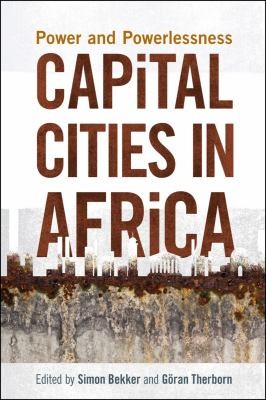
Capital Cities in Africa
0
0
As an Amazon Associate and affiliate partner, Menrva Books earns from qualifying purchases. Learn more
Author Description
Capital cities today remain central to both nations and states. They host centres of political power, not only national, but in some cases regional and global as well, thus offering major avenues to success, wealth and privilege. For these reasons capitals simultaneously become centres of "counter-power", locations of high-stakes struggles between the government and the opposition. This volume focuses on capital cities in nine sub-Saharan African countries, and traces how the power vested in them has evolved through different colonial backgrounds, radically different kinds of regimes after independence, waves of popular protest, explosive population growth and in most cases stunted economic development. Starting at the point of national political emancipation, each case study explores the complicated processes of nation-state building through its manifestation in the "urban geology" of the city - its architecture, iconography, layout and political use of urban space. Although the evolution of each of these cities is different, they share a critical demographic feature: an extraordinarily rapid process of urbanisation that is more politically than economically driven. Overwhelmed by the inevitable challenges resulting from this urban sprawl, the governments seated in most of these capital cities are in effect both powerful - wielding power over their populace -and powerless, lacking power to implement their plans and to provide for their inhabitants
Menrva's Summary
THE THESIS
Capital cities in Africa serve as concentrated hubs of political power, wealth, and privilege, simultaneously becoming focal points for struggles between governments and opposition. The book examines nine sub-Saharan African capital cities, tracing the evolution of their power structures through diverse colonial legacies, post-independence regimes, popular protests, rapid urbanization, and economic challenges. It analyzes nation-state building through the lens of urban geology, including architecture, iconography, and the political use of urban space. A critical demographic feature shared by these cities is politically driven, rapid urbanization, which often overwhelms governmental capacity to manage growth and provide for inhabitants.
THE SCOPE MAP
- Analysis of capital cities in nine sub-Saharan African countries.
- Exploration of power dynamics shaped by colonial backgrounds and post-independence regimes.
- Examination of nation-state building through urban development, architecture, and iconography.
- Focus on the impact of popular protests and rapid, politically driven urbanization.
- Discussion of the challenges faced by governments in managing urban sprawl and providing services.
- Case studies detailing the 'urban geology' and political use of urban space.
THE AUTHORITY PERSPECTIVE
This volume is presented as a scholarly examination of the complex role of capital cities in sub-Saharan Africa. The publisher's description highlights the book's focus on the interplay between political power, urbanization, and state-building processes. It suggests that the work offers detailed case studies contributing to a deeper understanding of the unique challenges and dynamics within these urban centers. The approach emphasizes the physical and spatial manifestations of power within the urban landscape.
Page Count:
220
Publication Date:
2012-01-01
ISBN-10:
0796923507
ISBN-13:
9780796923509
Politics
History
Science
Non-Fiction
Sociology
Urban Studies
Community Tags
Similar Books