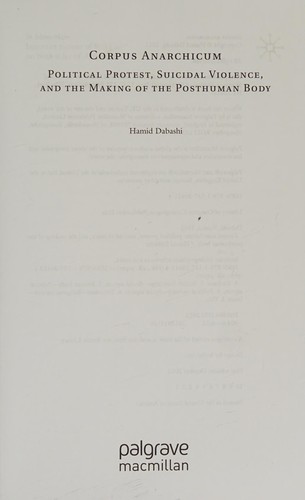
Corpus Anarchicum
0
0
As an Amazon Associate and affiliate partner, Menrva Books earns from qualifying purchases. Learn more
Author Description
This book is a meditation on and attempt to understand suicidal violence in the immediate context of its most recent political surge--the decade between 2001 and 2011, from the suicidal mission of Muhammad Atta and his band in the United States to the suicide of Mohamed Bouazizi in 2010 in Tunisia. After the former a devastating military strike and occupation of two Muslim countries commenced, and after the latter a massive transnational democratic uprising ensured. Suicidal violence is neither specific to Islam nor peculiar to our time, but the suicidal violence we witness today is of an entirely different disposition because the bodies on which it is perpetrated (both of the assailant and of the assailed) are no longer the human body of our belated Enlightenment assumption. What we are witnessing is in fact the contour of a posthuman body. The posthuman body, as Dabashi here proposes, is the body of a contingent and contextual being, and as such an object of disposable knowledge, while the human body that it has superseded was corporeally integral, autonomous, rational, indispensable, and above all the site of a knowing subject.
Menrva's Summary
THE THESIS
This book investigates the nature and implications of suicidal violence in the context of the posthuman body. Hamid Dabashi, a professor of comparative literature and critical theory, examines the decade between 2001 and 2011, a period marked by significant acts of suicidal violence and their profound geopolitical consequences. The book posits that contemporary suicidal violence signifies a shift towards a 'posthuman body,' distinct from the rational, autonomous human body of the Enlightenment, and explores the philosophical and political ramifications of this transformation.
THE SCOPE MAP
- Analysis of suicidal violence from 2001-2011, including events like the 9/11 attacks and Mohamed Bouazizi's self-immolation.
- Exploration of the concept of the 'posthuman body' as a contingent and disposable entity.
- Critique of the Enlightenment understanding of the human body as integral, autonomous, and rational.
- Examination of the political and social consequences of suicidal violence in the contemporary era.
- Discussion of how the nature of violence has changed with the perceived shift from the human to the posthuman body.
THE AUTHORITY PERSPECTIVE
The book offers a critical examination of suicidal violence, framing it within a broader philosophical discussion of the posthuman condition. It challenges conventional understandings of the human body and its role in political acts. The analysis connects specific historical events to a theoretical framework, suggesting that contemporary violence is indicative of a fundamental shift in how we conceive of the body and subjectivity. This work is likely to appeal to scholars and readers interested in critical theory, political philosophy, and the sociology of violence.
Page Count:
235
Publication Date:
2012-01-01
ISBN-10:
113726411X
ISBN-13:
9781137264114
Politics
Science
History
Philosophy
Non-Fiction
Sociology
Community Tags
Similar Books