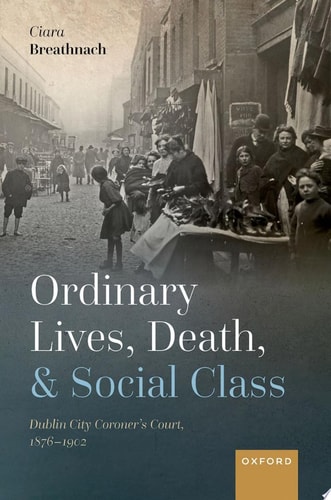
Ordinary Lives, Death, and Social Class: Dublin City Coroner's Court, 1876-1902
0
0
As an Amazon Associate and affiliate partner, Menrva Books earns from qualifying purchases. Learn more
Author Description
Ordinary Lives, Death, and Social Class focuses on the evolution of the Dublin City Coroner's Court and on Dr Louis A. Bryne's first two years in office. Wrapping itself around the 1901 census, the study uses gender, power, and blame as analytical frameworks to examine what inquests can tell us about the impact of urban living from lifecycle and class perspectives. Coroners' inquests are a combination of eyewitness testimony, expert medico-legal language, detailed minutiae of people, places, and occupational identities pinned to a moment in time. Thus they have a simultaneous capacity to reveal histories from both above and below. Rich in geographical, socio-economic, cultural, class, and medical detail, these records collated in a liminal setting about the hour of death bear incredible witness to what has often been termed 'ordinary lives'. The subjects of Dr Byrne's court were among the poorest in Ireland and, apart from common medical causes problems linked to lower socio-economic groups, this volume covers preventable cases of workplace accidents, neglect, domestic abuse, and homicide.
Menrva's Summary
THE THESIS
This study investigates how the Dublin City Coroner's Court records from 1876 to 1902 illuminate the intersection of urban living, social class, and mortality in late nineteenth-century Ireland. Ciara Breathnach, a historian specializing in Irish social and medical history, utilizes the inquest records of Dr. Louis A. Byrne to reconstruct the lives of the city's impoverished populations. By applying analytical frameworks of gender, power, and blame, the author argues that these medico-legal documents provide a unique window into the socio-economic realities and preventable deaths of the urban poor.
THE SCOPE MAP
What You Will Find
- Analysis of Dublin City Coroner's Court records spanning the years 1876 to 1902.
- Examination of the 1901 census data in relation to mortality and occupational identity.
- Case studies covering workplace accidents, domestic abuse, neglect, and homicide.
- A methodological framework for interpreting medico-legal testimony as a source for social history.
THE AUTHORITY PERSPECTIVE
Scholars in Irish social history identify this work as a significant contribution to the study of urban poverty and the evolution of medico-legal institutions. Readers frequently note the meticulous use of archival evidence to bridge the gap between clinical records and the lived experiences of the marginalized.
Page Count:
288
Publication Date:
2022-12-15
Publisher:
Oxford University Press
ISBN-10:
0198865783
ISBN-13:
9780198865780
History
Social History
Great Britain
Ireland
Legal History
MEDICAL History
Community Tags
Similar Books