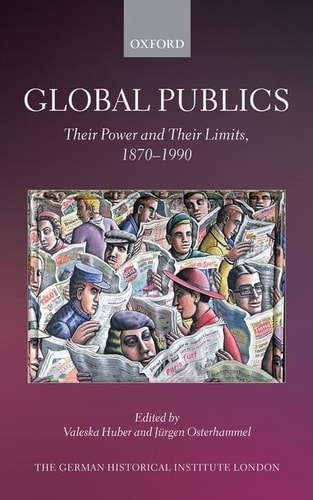
Global Publics: Their Power and Their Limits, 1870-1990
0
0
As an Amazon Associate and affiliate partner, Menrva Books earns from qualifying purchases. Learn more
Author Description
This volume combines a present-day and historical concern on the topic of global publics between the communication revolution of the 1870s and the digital age. Building on earlier theories of public spheres, Valeska Huber and Jürgen Osterhammel expand the notion of global publics not only geographically but also by charting new thematic territory, describing global publics as courts of global opinion, as market places, or as arenas for competition. As the first historical volume ever to combine different facets of global publics ranging from infrastructures, the press, film and theatre to human rights politics, it brings together established and emerging authors in the field of history and from related disciplines such as geography, sociology, and literature who explore how global publics were configured, imagined, and fragmented. In this way, Global Publics: Their Power and Their Limits not only provides a new conceptual framework and important case studies but also shows how histories of global communication might be studied in the future.
Menrva's Summary
THE THESIS
This volume investigates the historical evolution, structural power, and inherent limitations of global publics from the communication revolution of the 1870s through the late 20th century. Editors Jürgen Osterhammel and Valeska Huber, both distinguished scholars in global and modern history, curate a collection of essays that challenge traditional theories of the public sphere. By synthesizing perspectives from geography, sociology, and literature, the authors argue that global publics function as dynamic arenas for competition, market exchange, and moral adjudication rather than static entities.
THE SCOPE MAP
What You Will Find
- Historical analysis of communication infrastructures from 1870 to 1990.
- Examination of diverse media formats including the press, film, and theatre.
- Case studies on the intersection of global public opinion and human rights politics.
- A conceptual framework for understanding how global publics are configured, imagined, and fragmented.
THE AUTHORITY PERSPECTIVE
Experts identify this volume as a significant contribution to the field of global history, particularly for its interdisciplinary approach to communication studies. Readers frequently note the academic density of the prose, which serves as a foundational text for scholars interested in the intersection of technology, politics, and social organization.
Page Count:
423
Publication Date:
2020-07-28
Publisher:
Oxford University Press
ISBN-10:
0198865775
ISBN-13:
9780198865773
History
Global Studies
Communication Studies
Geography
Sociology
Community Tags
Similar Books