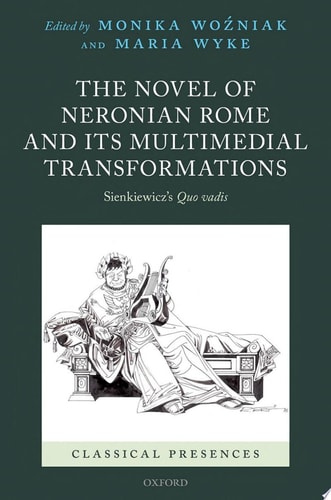
The Novel of Neronian Rome and its Multimedial Transformations: Sienkiewicz's Quo vadis
0
0
As an Amazon Associate and affiliate partner, Menrva Books earns from qualifying purchases. Learn more
Author Description
The Polish writer Henryk Sienkiewicz was awarded the Nobel Prize for literature in 1905 largely on the basis of his historical novel Quo vadis: A Narrative of the Time of Nero. The novel's vivid and moving reconstruction of religious persecution and struggle against tyranny catapulted its author into literary stardom. But, before long, Quo vadis began to 'detach' itself from the person of its author and to become a multimedial, mass culture phenomenon. In the West and in the East, it was adapted for stage and screen, provided the inspiration for works of music and other genres of literature, was transformed into comic strips and illustrated children's books, was cited in advertising, and referenced in everyday objects of material culture. This volume explores the strategies Sienkiewicz used to recreate Neronian Rome and the reasons his novel was so avidly consumed and reproduced in new editions, translations, visual illustrations, and adaptations to the stage and screen across Europe and in the United States. The contributions render visible for English-speaking readers the impact of a Polish work of high literature on the presence of Nero, Christian persecution, and ancient Rome in Western popular culture.
Menrva's Summary
THE THESIS
This volume investigates how Henryk Sienkiewicz’s historical novel Quo vadis transcended its literary origins to become a pervasive multimedial phenomenon within global popular culture. The authors, Maria Wyke and Monika Woźniak, utilize a multidisciplinary approach to examine the intersection of classical reception, mass media adaptation, and the socio-political context of the early twentieth century. By analyzing the novel's transition into film, theater, and material culture, the text argues that Sienkiewicz’s reconstruction of Neronian Rome fundamentally altered the Western perception of ancient history.
THE SCOPE MAP
What You Will Find
- Analysis of the literary strategies employed by Sienkiewicz to depict Neronian Rome.
- Examination of the novel's adaptation history across stage, screen, and print media.
- Investigation into the cultural impact of the work in both Western and Eastern European contexts.
- Discussion of the role of visual illustrations, advertising, and material culture in sustaining the novel's popularity.
THE AUTHORITY PERSPECTIVE
Scholars in the field of classical reception view this volume as a significant contribution to understanding how high literature is recontextualized for mass audiences. The text is noted for its rigorous academic approach to the evolution of the Quo vadis narrative across diverse media platforms.
Page Count:
352
Publication Date:
2021-02-16
Publisher:
Oxford University Press
ISBN-10:
0198867530
ISBN-13:
9780198867531
History
Literary Criticism
Film History
Media Studies
Community Tags
Similar Books