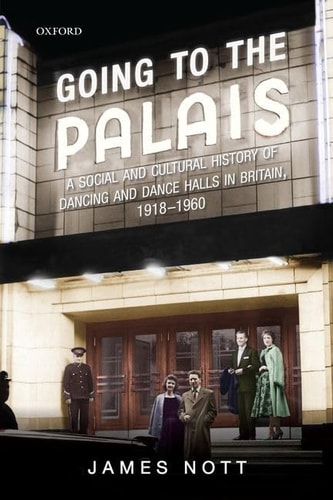
Going to the Palais: A Social and Cultural History of Dancing and Dance Halls in Britain, 1918-1960
0
0
As an Amazon Associate and affiliate partner, Menrva Books earns from qualifying purchases. Learn more
Author Description
From the mid-1920s, the dance hall occupied a pivotal place in the culture of working- and lower-middle-class communities in Britain - a place rivalled only by the cinema and eventually to eclipse even that institution in popularity. Going to the Palais examines the history of this vital social and cultural institution, exploring the dances, dancers, and dance venues that were at the heart of one of twentieth-century Britain's most significant leisure activities.Going to the Palais has several key focuses. First, it explores the expansion of the dance hall industry and the development of a 'mass audience' for dancing between 1918 and 1960. Second, the impact of these changes on individuals and communities is examined, with a particular concentration on working and lower-middle-class communities, and on young men and women. Third, the cultural impact of dancing and dance halls is explored. A key aspect of this debate is an examination of how Britain's dance culture held up against various standardizing processes (for example, commercialization, Americanization) over the period, and whether we can see the emergence of a 'national' dance culture. Finally, the volume offers an assessment of wider reactions to dance halls and dancing in the period. Going to the Palais is concerned with the complex relationship between discourses of class, culture, gender, and national identity and how they overlap - how cultural change, itself a response to broader political, social, and economic developments, was helping to change notions of class, gender, and national identity.
Menrva's Summary
THE THESIS
This book investigates the rise and cultural significance of the dance hall as a central institution in British social life between 1918 and 1960. James Nott, a historian specializing in twentieth-century British culture, utilizes a wide array of primary sources and social data to analyze how dance halls functioned as spaces for community formation and identity negotiation. The author argues that these venues were not merely sites of leisure, but critical arenas where class, gender, and national identity were actively reshaped in response to broader economic and political shifts.
THE SCOPE MAP
What You Will Find
- An analysis of the commercial expansion of the dance hall industry across the interwar and post-war periods.
- Examination of the influence of Americanization and commercial standardization on British leisure habits.
- Case studies focusing on the experiences of working-class and lower-middle-class youth.
- A detailed exploration of the intersection between gender dynamics and public social spaces.
THE AUTHORITY PERSPECTIVE
Historians and sociologists frequently cite this work as a definitive study on the evolution of British popular culture during the mid-twentieth century. Scholars note the text's rigorous approach to archival research and its ability to connect localized social practices to larger national trends.
Page Count:
344
Publication Date:
2020-08-18
Publisher:
Oxford University Press
ISBN-10:
0198866631
ISBN-13:
9780198866633
History
Educational Resources
Great Britain
Europe
Social History
Dance
Kindle Store
Cultural History
Sociology
Kindle eBooks
British History
Categories
Community Tags
Similar Books