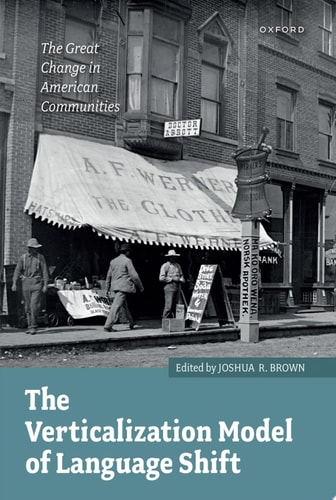
The Verticalization Model of Language Shift: The Great Change in American Communities
0
0
As an Amazon Associate and affiliate partner, Menrva Books earns from qualifying purchases. Learn more
Author Description
This book introduces a new and still emerging theoretical framework for understanding language shift and uses this approach to explore a range of minority language communities in the United States. To date, approaches to language shift have typically relied on explaining the process through descriptive sociolinguistic models, i.e., how the community first becomes bilingual in both the majority and minority languages and then eventually shifts entirely to the majority language. The contributions in this volume instead attribute shift to a change from local control of tightly interconnected 'horizontal' institutions within a community to more external or 'vertical' control of those increasingly autonomous institutions outside the community; in short, language shift is driven by specific changes in community structure. In addition, unlike previous approaches to language shift, the one proposed here is generalizable.Following an introduction to the theory, the main five chapters in the book offer case studies of individual language communities, in different contexts and different periods. The final three chapters of the book take a broader perspective, looking beyond the United States: two leading specialists in the field provide critical commentaries on the theoretical approach and offer refinements to a theory of language shift, before a concluding chapter draws together the findings of the case studies and reflections on the commentaries. The volume will appeal to researchers and students in the fields of language revitalization, community studies, sociolinguistics, and social history.
Menrva's Summary
THE THESIS
This volume investigates whether language shift in minority communities is driven by the structural transition from local, horizontal institutional control to external, vertical institutional control. Edited by Joshua R. Brown, the text challenges traditional descriptive sociolinguistic models that focus primarily on the progression of bilingualism. By proposing a generalizable framework, the contributors argue that language loss is a byproduct of shifting community autonomy and external integration rather than mere linguistic assimilation.
THE SCOPE MAP
What You Will Find
- A theoretical framework defining the transition from horizontal to vertical institutional structures.
- Five distinct case studies of minority language communities within the United States.
- Critical commentaries from field specialists evaluating the applicability of the verticalization model.
- A concluding synthesis that integrates empirical findings with theoretical refinements.
THE AUTHORITY PERSPECTIVE
Experts identify this volume as a significant contribution to the study of language revitalization and community sociology. Readers frequently note the academic density of the prose, which is intended for researchers and students familiar with sociolinguistic methodology.
Page Count:
256
Publication Date:
2022-10-31
Publisher:
Oxford University Press
ISBN-10:
0198864639
ISBN-13:
9780198864639
Social History
Linguistics
Community Studies
Social Science
Community Tags
Similar Books