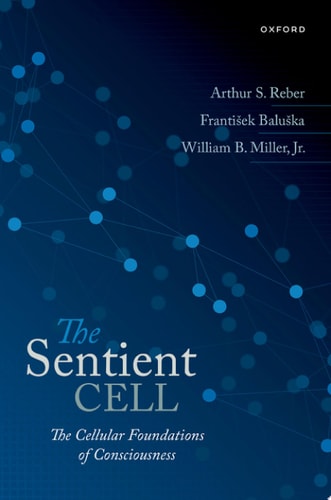
The Sentient Cell: The Cellular Foundations of Consciousness
0
0
As an Amazon Associate and affiliate partner, Menrva Books earns from qualifying purchases. Learn more
Author Description
All species, extant and extinct, from the simplest unicellular prokaryotes to humans, have an existential consciousness. Without sentience, the first cells that emerged some 4 billion years ago would have been evolutionary dead-ends, unable to survive in the chaotic, dangerous environment in which life first appeared and evolved. In this book, Arthur Reber's theory, the Cellular Basis of Consciousness (CBC), is outlined and distinguished from those models that argue that minds could be instantiated on artificial entities and those that maintain consciousness requires a nervous system.The CBC framework takes a novel approach to classic topics such as the origin-of-life, philosophy of mind, the role of genes, the impact of cognition, and how biological information is processed by all species. It also calls for a rethinking of a variety of issues including the moral implications of the sentient capacities of all species, how welfare concerns need to be expanded beyond where they currently are, and critically, how all life is intertwined in a coordinated cognitive ecology.The Sentient Cell explores this revolutionary model, which updates the standard neo-Darwinian framework within which current approaches operate and examines the underlying biomolecular features that are the likely candidates for the "invention" of consciousness and outline their role in cellular life.
Menrva's Summary
THE THESIS
This book investigates the hypothesis that consciousness is not a product of complex nervous systems, but a fundamental property inherent in all cellular life. The authors, Arthur S. Reber, Frantisek Baluska, and William Miller, utilize the Cellular Basis of Consciousness (CBC) framework to challenge traditional neo-Darwinian models. By examining the biomolecular mechanisms of unicellular organisms, they argue that sentience was a prerequisite for the survival and evolution of the earliest life forms four billion years ago. The text systematically contrasts this biological perspective against computational theories of mind and neurocentric definitions of awareness.
THE SCOPE MAP
What You Will Find
- The Cellular Basis of Consciousness (CBC) theoretical framework
- Comparative analysis of prokaryotic survival strategies and cognitive processes
- Critique of artificial intelligence models regarding the instantiation of mind
- Ethical implications for animal welfare and the moral status of non-neural organisms
- Examination of biomolecular candidates for the origin of biological information processing
THE AUTHORITY PERSPECTIVE
Experts in the philosophy of biology and cognitive science note the provocative nature of this text in challenging established neurocentric paradigms. Readers frequently highlight the academic density of the prose, which requires a foundational understanding of both evolutionary biology and philosophy of mind to fully engage with the authors' arguments.
Page Count:
288
Publication Date:
2024-01-01
Publisher:
Oxford University Press
ISBN-10:
0198873212
ISBN-13:
9780198873211
Philosophy
Science
Biology
Evolutionary Biology
Neuroscience
Community Tags
Similar Books