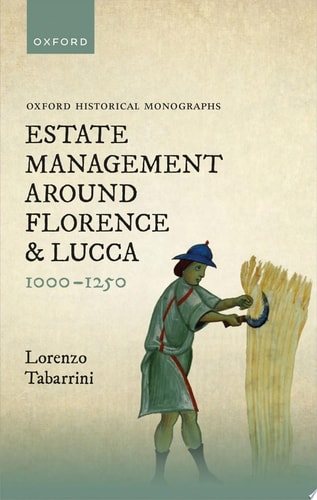
Estate Management around Florence and Lucca 1000-1250
0
0
As an Amazon Associate and affiliate partner, Menrva Books earns from qualifying purchases. Learn more
Author Description
This book examines the forms of estate management in the countryside of Florence and Lucca between the eleventh and the middle of the thirteenth centuries. It argues that their change reflects wider transformations of medieval economic patterns, and specifically the surge in overall demand that occurred in the decades bridging the twelfth and the thirteenth centuries.The reasons for a comparison between the Florentine and the Lucchese countryside lie in the alleged differences of their historical evolution--as it has been outlined by scholars so far. The so-called manorial system (sistema curtense) is believed to have ceased to exist in the Lucchesia around the beginning of the tenth century, whereas in the Fiorentino its disappearance can be dated to the early thirteenth century. Similarly, the Florentine countryside is generally regarded as the birthplace of a particular type of sharecropping regime, the mezzadria poderale, which spread over much of central Italy during the fifteenth and sixteenth centuries and would later become an essential component of Italian agrarian identity. On the contrary, the mezzadria poderale is thought to have never developed at any point in the history of medieval and early modern Lucchesia--and this was indeed the case with all the coastal areas of Tuscany. The book endeavours to examine the characteristics of estate management in the central Middle Ages in their own right; that is to say, by detaching those transformations from any teleological view, and by placing them within the economic and sociopolitical context of the period 1000-1250.
Menrva's Summary
THE THESIS
This book investigates the evolution of estate management practices in the Florentine and Lucchese countrysides between the eleventh and thirteenth centuries to determine how these shifts reflect broader medieval economic transformations. Dr. Lorenzo Tabarrini utilizes a comparative historical framework to challenge established scholarly narratives regarding the timeline of the manorial system and the origins of the mezzadria poderale sharecropping regime. By analyzing regional economic data, the author argues that these changes were driven by a surge in overall demand during the twelfth and thirteenth centuries rather than isolated local developments. The study seeks to detach these agrarian shifts from teleological interpretations, placing them firmly within their specific sociopolitical context.
THE SCOPE MAP
What You Will Find
- Comparative analysis of agrarian systems in the Florentine and Lucchese regions from 1000 to 1250.
- Examination of the transition from the manorial system (sistema curtense) to alternative management models.
- Investigation into the origins and regional development of the mezzadria poderale sharecropping regime.
- Synthesis of economic patterns and sociopolitical factors influencing medieval land management.
THE AUTHORITY PERSPECTIVE
Scholars recognize this work as a rigorous contribution to the study of Italian medieval economic history, particularly for its critical re-evaluation of regional agrarian models. Readers frequently note the academic density of the prose, which serves as a specialized resource for historians focusing on the central Middle Ages.
Page Count:
256
Publication Date:
2023-01-01
Publisher:
Oxford University Press
ISBN-10:
0198875150
ISBN-13:
9780198875154
History
Agriculture
Middle Ages
Italy
Europe
Historical geography
Economic History
Community Tags
Similar Books