English Renaissance Manuscript Culture: The Paper Revolution
0
0
As an Amazon Associate and affiliate partner, Menrva Books earns from qualifying purchases. Learn more
Author Description
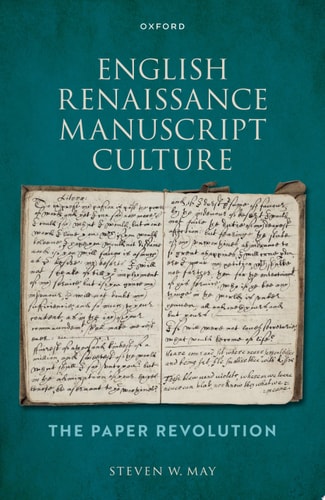
English Renaissance Manuscript Culture: The Paper Revolution traces the development of a new type of scribal culture in England that emerged early in the fourteenth century. The main medieval writing surfaces of parchment and wax tablets were augmented by a writing medium that was both lasting and cheap enough to be expendable. Writing was transformed from a near monopoly of professional scribes employed by the upper class to a practice ordinary citizens could afford. Personal correspondence, business records, notebooks on all sorts of subjects, creative writing, and much more flourished at social levels where they had previously been excluded by the high cost of parchment. Steven W. May places literary manuscripts and in particular poetic anthologies in this larger scribal context, showing how its innovative features affected both authorship and readership.As this amateur scribal culture developed, the medieval professional culture expanded as well. Classes of documents formerly restricted to parchment often shifted over to paper, while entirely new classes of documents were added to the records of church and state as these institutions took advantage of relatively inexpensive paper.Paper stimulated original composition by making it possible to draft, revise, and rewrite works in this new, affordable medium. Amateur scribes were soon producing an enormous volume of manuscript works of all kinds--works they could afford to circulate in multiple copies. England's ever-increasing literate population developed an informal network that transmitted all kinds of texts from single sheets to book-length documents efficiently throughout the kingdom. The operation of restrictive coteries had little if any role in the mass circulation of manuscripts through this network. However, paper was cheap enough that manuscripts could also be readily disposed of (unlike expensive parchment). More than 90% of the output from this scribal tradition has been lost, a fact that tends to dist
Menrva's Summary
THE THESIS
This work investigates how the introduction of affordable paper in fourteenth-century England democratized literacy and transformed the production, circulation, and preservation of written texts. Steven W. May, a scholar of Renaissance literature, utilizes historical records and surviving manuscript evidence to argue that paper acted as a catalyst for a new scribal culture. By shifting writing away from the exclusive domain of professional scribes and expensive parchment, the medium enabled ordinary citizens to engage in personal correspondence, creative writing, and record-keeping. The book posits that this transition fundamentally altered the relationship between authors and their readers by fostering an informal, kingdom-wide network of text transmission.
THE SCOPE MAP
What You Will Find
- Analysis of the transition from parchment and wax tablets to paper as the primary writing medium.
- Examination of how paper facilitated drafting, revision, and the mass circulation of amateur literary works.
- Investigation into the expansion of institutional record-keeping within church and state bureaucracies.
- Discussion of the loss of over 90% of the manuscript output due to the expendable nature of paper.
THE AUTHORITY PERSPECTIVE
Scholars recognize this text as a significant contribution to the study of early modern scribal practices and the material history of the book. Readers frequently note the academic density of the prose and the author's meticulous attention to the socio-economic factors that shaped English literacy.
Page Count:
288
Publication Date:
2023-01-01
Publisher:
Oxford University Press
ISBN-10:
0198878001
ISBN-13:
9780198878001
History
Literary Criticism
Book History
Cultural History
Community Tags
Similar Books