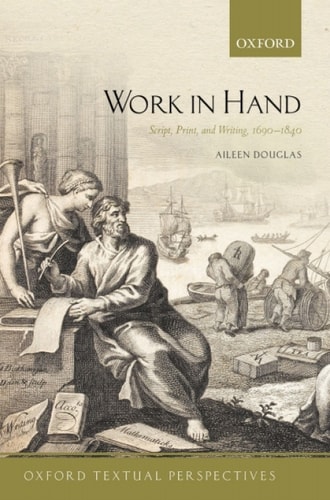
Work in Hand: Script, Print, and Writing, 1690-1840
0
0
As an Amazon Associate and affiliate partner, Menrva Books earns from qualifying purchases. Learn more
Author Description
Oxford Textual Perspectives is a new series of informative and provocative studies focused upon literary texts (conceived of in the broadest sense of that term) and the technologies, cultures and communities that produce, inform, and receive them. It provides fresh interpretations of fundamental works and of the vital and challenging issues emerging in English literary studies. By engaging with the materiality of the literary text, its production, and reception history, and frequently testing and exploring the boundaries of the notion of text itself, the volumes in the series question familiar frameworks and provide innovative interpretations of both canonical and less well-known works. Work in Hand: Script, Print, and Writing, 1690-1840 argues that between the late seventeenth and early nineteenth centuries manual writing was a dynamic technology. It examines script in relation to becoming a writer; in constructions of the author; and in emerging ideas of the human. Revising views of print as displacing script, Work in Hand argues that print reproduced script, print generated script; and print shaped understandings of script. In this, the double nature of print, as both moveable type and rolling press, is crucial. During this period, the shapes of letters changed as the multiple hands of the early-modern period gave way to English round hand; the denial of writing to the labouring classes was slowly replaced by acceptance of the desirability of universal writing; understandings of script in relation to copying and discipline came to be accompanied by ideas of the autograph. The work begins by surveying representations of script in letterpress and engraving. It discusses initiation into writing in relation to the copy-books of English writing masters, and in the context of colonial pedagogy in Ireland and India. The middle chapters discuss the physical work of writing, the material dimensions of script, and the autograph, in constructions of the author in the late e
Menrva's Summary
THE THESIS
This book investigates the role of manual writing as a dynamic technology between 1690 and 1840, challenging the assumption that print culture simply displaced script. Aileen Douglas, a scholar of eighteenth-century literature, utilizes historical analysis of pedagogical materials, engraving, and literary production to argue that print and script existed in a symbiotic relationship. She posits that print did not merely replace handwriting but actively reproduced, generated, and shaped cultural understandings of the written word during this transformative period.
THE SCOPE MAP
What You Will Find
- Analysis of the transition from early-modern multiple hands to English round hand.
- Examination of colonial pedagogy in Ireland and India regarding writing instruction.
- Exploration of the material dimensions of script, including the role of copy-books and the emergence of the autograph.
Scope Limits
- The study focuses primarily on the British and colonial context rather than a global history of writing.
- The analysis is restricted to the timeframe of 1690 to 1840.
THE AUTHORITY PERSPECTIVE
Scholars in the field of textual studies recognize this work as a significant contribution to understanding the materiality of literature. Readers frequently note the academic density of the prose and the author's meticulous attention to the intersection of print technology and social history.
Page Count:
208
Publication Date:
2017-01-01
Publisher:
OUP Oxford
ISBN-10:
0192506218
ISBN-13:
9780192506214
Cultural History
Academic
18th century
Printing
Literary Criticism
Book History
English
English Composition
English & College Success
Community Tags
Similar Books