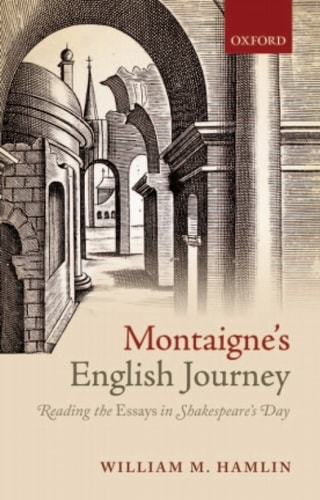
Montaigne's English Journey: Reading the Essays in Shakespeare's Day
0
0
As an Amazon Associate and affiliate partner, Menrva Books earns from qualifying purchases. Learn more
Author Description
Montaigne's English Journey examines the genesis, early readership, and multifaceted impact of John Florio's exuberant translation of Michel de Montaigne's Essays. Published in London in 1603, this book was widely read in seventeenth-century England: Shakespeare borrowed from it as he drafted King Lear and The Tempest, and many hundreds of English men and women first encountered Montaigne's tolerant outlook and disarming candour in its densely-printed pages. Literary historians have long been fascinated by the influence of Florio's translation, analysing its contributions to the development of the English essay and tracing its appropriation in the work of Webster, Dryden, and other major writers. William M. Hamlin, by contrast, undertakes an exploration of Florio's Montaigne within the overlapping realms of print and manuscript culture, assessing its importance from the varied perspectives of its earliest English readers. Drawing on letters, diaries, commonplace books, and thousands of marginal annotations inscribed in surviving copies of Florio's volume, Hamlin offers a comprehensive account of the transmission and reception of Montaigne in seventeenth-century England. In particular he focuses on topics that consistently intrigued Montaigne's English readers: sexuality, marriage, conscience, theatricality, scepticism, self-presentation, the nature of wisdom, and the power of custom. All in all, Hamlin's study constitutes a major contribution to investigations of literary readership in pre-Enlightenment Europe.
Menrva's Summary
THE THESIS
This study investigates the early reception and cultural impact of John Florio's 1603 translation of Michel de Montaigne's Essays within the context of seventeenth-century English society. William M. Hamlin, a scholar of Renaissance literature, utilizes a wide array of primary sources to reconstruct how early modern readers engaged with Montaigne's ideas. By examining marginalia, personal diaries, and commonplace books, the author argues that the translation served as a critical conduit for philosophical and social discourse in pre-Enlightenment England. The work provides a detailed framework for understanding how a foreign text was assimilated into the intellectual life of a specific historical period.
THE SCOPE MAP
What You Will Find
- Analysis of John Florio's 1603 translation of Montaigne's Essays.
- Examination of reader engagement through marginal annotations and personal records.
- Exploration of thematic interests including marriage, theatricality, and skepticism.
- Contextualization of the text within the broader print and manuscript culture of the era.
Scope Limits
- The study focuses primarily on the seventeenth-century English reception rather than the original French composition.
- It does not provide a comprehensive biography of Montaigne himself, focusing instead on the transmission of his work.
THE AUTHORITY PERSPECTIVE
Scholars recognize this work as a significant contribution to the study of early modern readership and the history of the book. Readers frequently note the meticulous archival research and the depth of the analysis regarding the intersection of print culture and individual intellectual development.
Page Count:
352
Publication Date:
2013-01-01
Publisher:
OUP Oxford
ISBN-10:
0191507024
ISBN-13:
9780191507021
History
Literary Criticism
Cultural History
Book History
English
English & College Success
English literature
Community Tags
Other Editions(2)

Similar Books