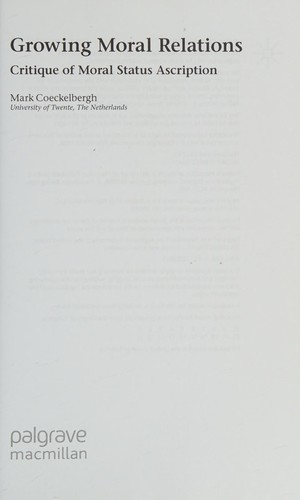
Growing Moral Relations
0
0
As an Amazon Associate and affiliate partner, Menrva Books earns from qualifying purchases. Learn more
Author Description
New scientific and technological developments challenge us to reconsider the moral status of entities such as chimpanzees or artificially intelligent robots: what place should we give them in our moral world order? Engaging with a variety of theoretical sources, this book offers a relational approach to moral status that questions individualist and objectivist assumptions made in these discussions, and proposes a less dualistic view by emphasizing the entanglement of natural, social, and technological relations. But it also asks why it is so hard to move towards a more relational understanding. The author's answer is an original discussion of the conditions of possibility of moral status ascription. Influenced by Heidegger and Wittgenstein, he argues that our specific way of ascribing moral status, and indeed the very project of moral status 'ascription', is made possible by, and limited by, particular linguistic, social-cultural, natural-bodily, material-technological, religious-spiritual, and historical-spatial conditions. The 'living' moral epistemology that emerges from this 'philosophical yoga' -an exercise in becoming more aware of your moral breathing - urges us to recognize that changing our moral thinking depends on the growth of our relations and hence of our form of life
Menrva's Summary
THE THESIS
This book investigates the moral standing of non-human entities in an era of rapid technological advancement. Engaging with theoretical sources, it proposes a relational approach to moral status, challenging individualist and objectivist assumptions by emphasizing the entanglement of natural, social, and technological relations. The work further explores the difficulties in adopting a relational understanding, examining the conditions that enable and limit our ability to ascribe moral status. Ultimately, it argues that evolving our moral thinking is intrinsically linked to the growth of our relations and our form of life.
THE SCOPE MAP
- A relational approach to moral status, questioning individualist and objectivist assumptions.
- Discussion on the moral status of entities like chimpanzees and artificial intelligence.
- Analysis of the conditions of possibility for moral status ascription, influenced by Heidegger and Wittgenstein.
- Exploration of linguistic, social-cultural, natural-bodily, material-technological, religious-spiritual, and historical-spatial conditions affecting moral status.
- An argument for a 'living' moral epistemology that emphasizes the growth of relations and form of life.
THE AUTHORITY PERSPECTIVE
The book offers a novel perspective on moral status by moving away from individualist and objectivist viewpoints towards a more relational understanding. It addresses contemporary ethical challenges posed by advancements in artificial intelligence and our understanding of animal consciousness. The author's philosophical approach, drawing on thinkers like Heidegger and Wittgenstein, provides a deep dive into the conditions that shape our moral judgments. This work is likely to appeal to scholars and students of ethics, philosophy of technology, and animal studies seeking to re-evaluate the foundations of moral consideration.
Page Count:
0
Publication Date:
2012-01-01
ISBN-10:
1137025956
ISBN-13:
9781137025951
Philosophy
Non-Fiction
Science
Technology Ethics
Ethics
Animal Ethics
Community Tags
Similar Books