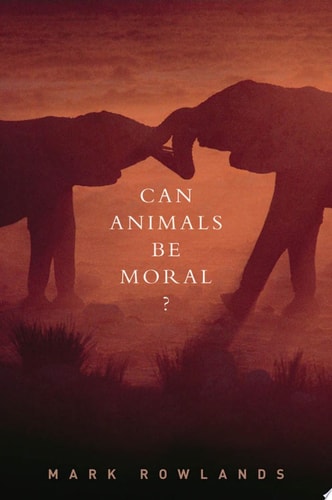
Can Animals Be Moral?
0
0
As an Amazon Associate and affiliate partner, Menrva Books earns from qualifying purchases. Learn more
Author Description
From eye-witness accounts of elephants apparently mourning the death of family members to an experiment that showed that hungry rhesus monkeys would not take food if doing so gave another monkey an electric shock, there is much evidence of animals displaying what seem to be moral feelings. But despite such suggestive evidence, philosophers steadfastly deny that animals can act morally, and for reasons that virtually everyone has found convincing.In Can Animals be Moral?, philosopher Mark Rowlands examines the reasoning of philosophers and scientists on this question--ranging from Aristotle and Kant to Hume and Darwin--and reveals that their arguments fall far short of compelling. The basic argument against moral behavior in animals is that humans have capabilities that animals lack. We can reflect on our motivations, formulate abstract principles that allow that allow us to judge right from wrong. For an actor to be moral, he or she must be able scrutinize their motivations and actions. No animal can do these things--no animal is moral. Rowland naturally agrees that humans possess a moral consciousness that no animal can rival, but he argues that it is not necessary for an individual to have the ability to reflect on his or her motives to be moral. Animals can't do all that we can do, but they can act on the basis of some moral reasons--basic moral reasons involving concern for others. And when they do this, they are doing just what we do when we act on the basis of these reasons: They are acting morally.
Menrva's Summary
THE THESIS
This book investigates whether animals possess the capacity for moral behavior, challenging the traditional philosophical consensus that morality requires abstract reflection. Mark Rowlands, a professor of philosophy, critiques historical and contemporary arguments from thinkers such as Aristotle, Kant, and Darwin. He posits that while humans possess a unique moral consciousness, the ability to reflect on one's motives is not a prerequisite for moral action, suggesting that animals can act on basic moral reasons involving concern for others.
THE SCOPE MAP
What You Will Find
- Analysis of historical philosophical arguments regarding animal cognition and morality.
- Examination of empirical evidence, including observational accounts of animal behavior and psychological experiments.
- A proposed framework for defining moral action that does not rely on human-centric cognitive requirements.
Scope Limits
- The text does not provide an exhaustive biological study of every animal species.
- It does not attempt to equate animal moral capacity with the full complexity of human moral consciousness.
THE AUTHORITY PERSPECTIVE
Experts and readers frequently note that the book provides a rigorous challenge to anthropocentric views on ethics. The prose is accessible to those interested in philosophy while maintaining the academic depth required to engage with complex ethical theories.
Page Count:
274
Publication Date:
2015-03-01
Publisher:
Oxford University Press
ISBN-10:
019024030X
ISBN-13:
9780190240301
Philosophy
Non-Fiction
Ethics history
Animal Ethics
Ethics
Community Tags
Other Editions(2)

Similar Books