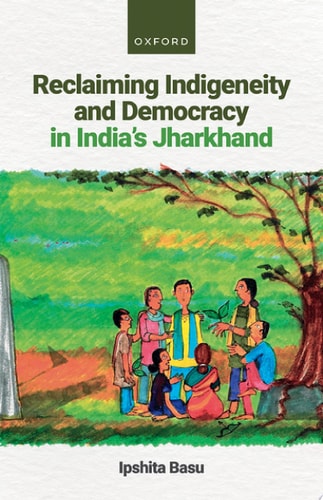
Reclaiming Indigeneity and Democracy in India's Jharkhand
0
0
As an Amazon Associate and affiliate partner, Menrva Books earns from qualifying purchases. Learn more
Author Description
Created in 2000 following a long-standing regional movement, Jharkhand-the land of forests-represents an important experiment in regional autonomy and self-determination for indigenous communities in a postcolonial democracy. Over two decades, Jharkhand has experienced a volatile political environment as competing political groups have mobilised indigenous subaltern communities for different ends. In Reclaiming Indigeneity and Democracy in India's Jharkhand, Ipshita Basu contributes to scholarship on critical social justice and indigeneity by highlighting 'relations of justification' as a central feature of group-based claims-making for social groups identifying with indigeneity in diverse ways. Specifically, the book focuses on reclaiming political recognition for Adivasis within the contemporary dynamics of majoritarian populism and the market economy. Uniting perspectives from philosophy (social justice), politics (democracy and public reasoning), and culture studies (identity), and based on ethnographic and archival research, the author indicates that when 'relations' are at the epicentre of claims-making, expressive attachments determine political activism over the instrumental choices that groups are compelled to make in the context of large power differentials. This book is a timely account of indigenous politics and is an attempt to foreground the complex 'political nature' of social justice claims-making in a democracy such as India.
Menrva's Summary
THE THESIS
This book investigates how indigenous communities in Jharkhand, India, navigate the complexities of political recognition and social justice within a landscape of majoritarian populism and market-driven economic pressures. Dr. Ipshita Basu, drawing upon her expertise in political philosophy and cultural studies, examines the 'relations of justification' that define how Adivasi groups articulate their claims for autonomy. By synthesizing ethnographic fieldwork with archival analysis, the author argues that expressive identity attachments often supersede instrumental political strategies when marginalized groups confront significant power imbalances in a postcolonial democracy.
THE SCOPE MAP
What You Will Find
- Analysis of the regional movement and political evolution of Jharkhand since its formation in 2000.
- A theoretical framework centered on 'relations of justification' in group-based claims-making.
- Qualitative evidence derived from extensive ethnographic research and historical archival records.
- An examination of the intersection between Adivasi identity, majoritarian populism, and the contemporary market economy.
THE AUTHORITY PERSPECTIVE
Scholars in the field of South Asian politics and indigenous studies recognize this work as a significant contribution to the understanding of subaltern political activism. Readers frequently note the academic density of the prose, which effectively bridges the gap between philosophical inquiry and empirical political analysis.
Page Count:
240
Publication Date:
2024-01-01
Publisher:
Oxford University Press
ISBN-10:
0198884672
ISBN-13:
9780198884675
Politics
Elections & Political Process
Sociology
Autochtones
Social justice
Democracy
Specific Topics
Community Tags
Similar Books