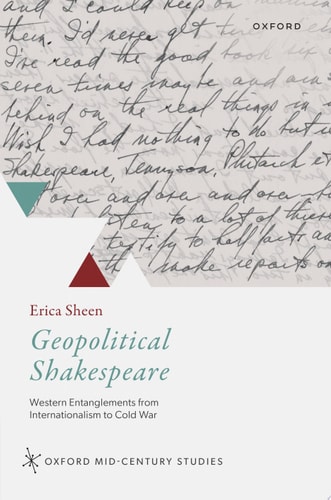
Geopolitical Shakespeare: Western Entanglements from Internationalism to Cold War
0
0
As an Amazon Associate and affiliate partner, Menrva Books earns from qualifying purchases. Learn more
Author Description
Geopolitical Shakespeare: Western Entanglements from Internationalism to Cold War examines the entanglement of Shakespearean culture in the geopolitical dynamics of the post-war West. Taking its cue from a speech given by Albert Einstein in London in 1933, in which Shakespeare is cited as an example of the Western value of personal and intellectual freedom, this book explores a series of events between 1945 and 1955 featuring key historical figures--scientists, international lawyers, diplomats and politicians, writers, actors, and filmmakers--who experienced the tensions of the early Cold War through Shakespeare, or called on him to articulate this new post-war world. Erica Sheen examines political, diplomatic, cultural, and economic interactions within 'core' Western power relations--the USA, UK, and Europe, with particular reference to Germany--in which Shakespeare, or the idea of Shakespeare, was entangled in the struggle for new ideas and social structures.The subjects of this book include John Humphrey and the drafting of the Universal Declaration of Human Rights; the Nuremberg Trials and the foundation of West Germany; Noel Annan and the Berlin Elizabethan Festival; an American production of Hamlet in Elsinore; Laurence Olivier, David Selznick, and the Shakespeare film in post-war Hollywood; Graham Greene and The Third Man; and Carl Schmitt and Salvador de Madariaga on Hamlet in post-war Europe. In each of these case studies, Sheen discovers a Shakespeare for our time: engaged in contestations of territoriality in cultures of international law and human rights, theatre, film, and literature.
Menrva's Summary
THE THESIS
This book investigates how Shakespearean culture functioned as a symbolic and rhetorical tool within the geopolitical power dynamics of the post-war West between 1945 and 1955. Erica Sheen, a scholar of literature and history, utilizes a series of specific case studies to analyze how diplomats, scientists, and artists invoked Shakespeare to define concepts of freedom, human rights, and territoriality. By examining the intersection of cultural production and international law, the author argues that Shakespeare was not merely a literary figure but an active participant in the construction of new social and political structures during the early Cold War.
THE SCOPE MAP
What You Will Find
- Analysis of the role of Shakespeare in the drafting of the Universal Declaration of Human Rights and the Nuremberg Trials.
- Examination of cultural diplomacy through the Berlin Elizabethan Festival and international theatrical productions.
- Case studies involving figures such as Laurence Olivier, Graham Greene, and Carl Schmitt.
- Exploration of the intersection between Shakespearean themes and the geopolitical tensions between the USA, UK, and Germany.
THE AUTHORITY PERSPECTIVE
Scholars and historians recognize this work as a significant contribution to the field of mid-century studies, particularly for its interdisciplinary approach to cultural history. Readers frequently note the academic density of the prose, which provides a rigorous examination of how literature is mobilized within international political frameworks.
Page Count:
256
Publication Date:
2024-01-01
Publisher:
Oxford University Press
ISBN-10:
0198888619
ISBN-13:
9780198888611
History
Cold War
Literary Criticism
International relations
Community Tags
Similar Books