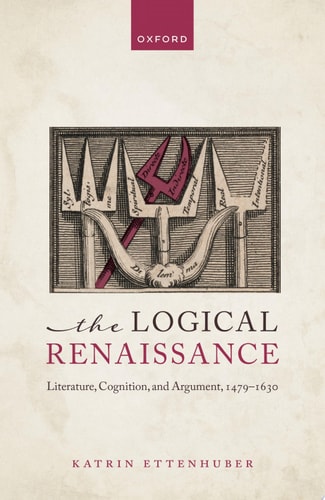
The Logical Renaissance: Literature, Cognition, and Argument, 1479-1630
Author Description
The Logical Renaissance: Literature, Cognition, and Argument, 1479-1630 is the first substantial account of early modern English literature's deep but uncharted relationship with logic. The nature and functions of logic have been largely misunderstood in literary criticism of the period, where it is often seen as sterile and formalistic: either an overcomplex remnant of Medieval philosophy superseded by rhetoric, or part of a Ramist pedagogy so stripped back that it had little to offer in the way of creative inspiration.Katrin Ettenhuber shows instead that early modern writers encountered in their study of logic a vibrantly practical art of argument and reasoning, which provided rich opportunities for imaginative engagement and artistic appropriation. The book opens with a clear and accessible introduction to the logical terms and concepts that will guide the discussion. It charts changes in logic education between the late fifteenth and early seventeenth centuries, before presenting a series of case studies that illustrate the creative applications of logic across a wide range of genres, including epic and lyric poetry, drama, and religious prose. The Logical Renaissance demonstrates, for the first time, logic's central role in the literary culture of early modern England.
Menrva's Summary
THE THESIS
This book investigates the historically overlooked influence of logic on the development of early modern English literature between 1479 and 1630. Katrin Ettenhuber, a scholar of early modern literature, challenges the prevailing critical view that logic was merely a sterile or formalistic discipline during this period. By examining pedagogical shifts and literary texts, she argues that logic functioned as a dynamic, practical art of reasoning that significantly shaped the creative output of the era's writers.
THE SCOPE MAP
What You Will Find
- A historical analysis of logic education in England from the late fifteenth to the early seventeenth century.
- An accessible primer on foundational logical concepts and terminology relevant to the period.
- Case studies applying logical frameworks to diverse genres including epic poetry, lyric poetry, drama, and religious prose.
- An examination of how writers appropriated logical structures for imaginative and artistic purposes.
THE AUTHORITY PERSPECTIVE
Scholars recognize this work as a significant intervention in early modern studies, effectively correcting long-standing misconceptions about the role of formal logic in literary creation. Readers frequently note the clarity of the author's prose, which makes complex philosophical and pedagogical history accessible to those outside the immediate field of logic.
Page Count:
320
Publication Date:
2024-01-01
Publisher:
Oxford University Press
ISBN-10:
0198881185
ISBN-13:
9780198881186
History
Philosophy
Poetry
Drama
Literary Criticism
Community Tags
Similar Books