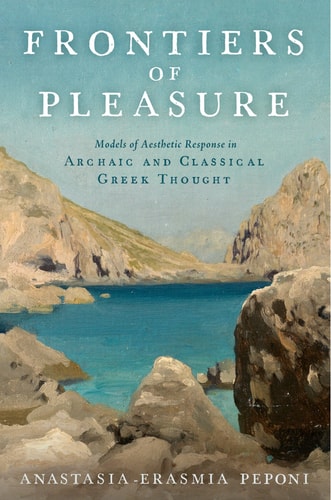
Frontiers of Pleasure: Models of Aesthetic Response in Archaic and Classical Greek Thought
0
0
As an Amazon Associate and affiliate partner, Menrva Books earns from qualifying purchases. Learn more
Author Description
Frontiers of Pleasure calls into question a number of influential modern notions regarding aesthetics by going back to the very beginnings of aesthetic thought in Greece and raising critical issues regarding conceptions of how one responds to the beautiful. Despite a recent rebirth of interest in aesthetics, extensive discussion of this key cluster of topics has been absent. Anastasia-Erasmia Peponi argues that although the Greek language had no formal term equivalent to the "aesthetic," the notion was deeply rooted in Greek thought. Her analysis centers on a dominant aspect of beauty--the aural--associated with a highly influential sector of culture that comprised both poetry and instrumental music, the "activity of the Muses," or mousikê. The main argument relies on a series of close readings of literary and philosophical texts, from Homer and Plato through Kant, Joyce, and Proust. Through detailed attention to such scenes as Odysseus' encounter with the Sirens and Hermes' playing of his lyre for his brother Apollo, she demonstrates that the most telling moments in the conceptualization of the aesthetic come in the Greeks' debates and struggles over intense models of auditory pleasure. Unlike current tendencies to treat poetry as an early, imperfect mode of meditating upon such issues, Peponi claims that Greek poetry and philosophy employed equally complex, albeit different, ways of articulating notions of aesthetic response. Her approach often leads her to partial or total disagreement with earlier interpretations of some of the most well-known Greek texts of the archaic and classical periods. Frontiers of Pleasure thus suggests an alternative mode of understanding aesthetics in its entirety, freed from some modern preconceptions that have become a hindrance within the field.
Menrva's Summary
THE THESIS
How did the ancient Greeks conceptualize the experience of beauty and aesthetic response in the absence of a formal term for the aesthetic? Anastasia-Erasmia Peponi, a scholar of classical literature and culture, examines the foundational role of auditory pleasure in archaic and classical Greek thought. By analyzing the intersection of poetry, music, and philosophy, she argues that the Greeks possessed a sophisticated, nuanced framework for aesthetic engagement that challenges modern scholarly assumptions.
THE SCOPE MAP
What You Will Find
- Analysis of the role of mousikê, the activity of the Muses, in shaping early aesthetic theory.
- Close readings of canonical texts ranging from Homer and Plato to modern thinkers like Kant and Proust.
- Examination of specific mythological scenes, such as the encounter between Odysseus and the Sirens, to illustrate auditory pleasure.
- A critical re-evaluation of the relationship between ancient poetic practice and philosophical inquiry.
THE AUTHORITY PERSPECTIVE
Scholars recognize this work as a significant contribution to the study of ancient aesthetics, particularly for its focus on the aural dimensions of beauty. The text is noted for its rigorous engagement with classical sources and its willingness to challenge established interpretations within the field of Greek studies.
Page Count:
224
Publication Date:
2012-08-02
Publisher:
Oxford University Press
ISBN-10:
019979832X
ISBN-13:
9780199798322
History
Philosophy
Literary Criticism
Greece
Poetry
Aesthetics
Musicology
Aesthetics history
Community Tags
Similar Books