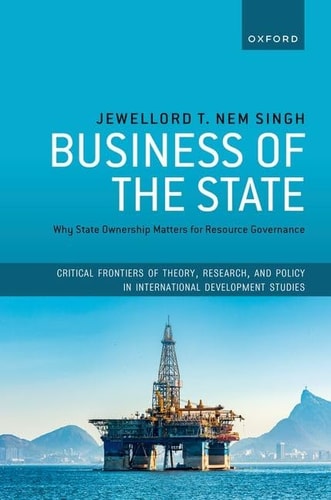
Business of the State: Why State Ownership Matters for Resource Governance
0
0
As an Amazon Associate and affiliate partner, Menrva Books earns from qualifying purchases. Learn more
Author Description
As the world moves towards decarbonization and the race for clean energy technologies accelerates, states in the global south are increasingly called upon to supply critical minerals to fuel the transition. Business of the State details how mineral states might design effective growth strategies in this context of strategic competition and climate emergency, via the rise of a hybrid developmental strategy during 1990s and 2010s- the embrace of market-conforming policies to attract FDI and the re-assertion of state-owned enterprises (SOEs) as players in industrial development. Drawing from the experiences of Brazil's Petrobras and Chile's Codelco, the book argues that SOEs might open new pathways for technological innovation and even support industrial policy, if subjected to effective governance reforms and aligned with the private sector. In this way, the book shifts the analytical lens away from extractivism as a growth model and towards hybrid development strategies formulated through SOEs.Business of the State asks fundamental questions about states and markets: why do states seek to intervene in the affairs of public enterprises? And what role might they play in structural transformation? The book provides answers using a historical institutionalist framework, process tracing the complex process of market reforms in highly strategic natural resource industries.
Menrva's Summary
THE THESIS
This book investigates how states in the global south can leverage state-owned enterprises (SOEs) to navigate the dual pressures of decarbonization and the global demand for critical minerals. Author Jewellord T. Nem Singh utilizes a historical institutionalist framework to analyze the evolution of hybrid developmental strategies between the 1990s and 2010s. By examining the interplay between market-conforming policies and state intervention, the work argues that reformed SOEs can serve as catalysts for technological innovation and industrial transformation rather than merely functioning as instruments of traditional extractivism.
THE SCOPE MAP
What You Will Find
- Comparative analysis of state-owned enterprises in Brazil and Chile, specifically Petrobras and Codelco.
- A historical institutionalist framework for evaluating market reforms in natural resource sectors.
- Process tracing methodology applied to the evolution of industrial policy and state intervention.
- Examination of the hybrid developmental model as a response to the global clean energy transition.
THE AUTHORITY PERSPECTIVE
Experts identify this work as a significant contribution to the study of political economy and resource governance in the global south. Readers frequently note the academic rigor of the process tracing methodology and the clarity with which the author bridges the gap between state theory and practical industrial policy.
Page Count:
368
Publication Date:
2024-10-11
Publisher:
Oxford University Press
ISBN-10:
0198892217
ISBN-13:
9780198892212
Economics
Industrial Policy
Public Policy
Natural Resources
International Development
Community Tags
Similar Books