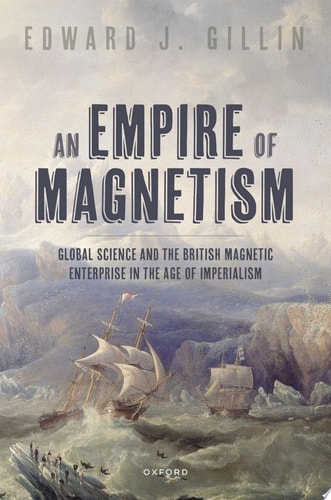
An Empire of Magnetism: Global Science and the British Magnetic Survey in the Age of Imperialism
0
0
As an Amazon Associate and affiliate partner, Menrva Books earns from qualifying purchases. Learn more
Author Description
During the 1840s and 1850s, the British government financed a world-wide investigation into how the Earth's magnetic phenomena operated, consisting of a network of naval expeditions and colonial observatories. Questions surrounding terrestrial magnetism were not just philosophical, but engendered urgent concerns over accurate navigation, on which Britain's commercial and colonial power relied.The British Magnetic Survey was celebrated at the time as the most extensive state-orchestrated scientific enterprise ever conducted. Yet although it was a fundamentally global endeavour, both in terms of its scale and its impact, the experimental instruments and techniques required were to be found amid Britain's booming local industry, where the harnessing of coal and iron, and use of steam power, shaped a scientific culture prominently concerned with the relationship between heat, pressure, and motion. In particular, it was philosophical apparatus fashioned within the mines of Cornwall that the government was able to conscript within this world-wide magnetic investigation. These locally produced experimental techniques and technologies proved capable of transformation into a system for obtaining magnetic measurements from over great expanses of time and space.As An Empire of Magnetism demonstrates, this not only sustained an immense world-wide scientific investigation, but became inseparable from the proliferation of empire, sustaining colonial expansion and unprecedented multi-cultural exchanges as British naval crews and natural philosophers surveyed previously unknown regions in the search for magnetic data. In so doing, Edward Gillin argues that the British Magnetic Survey had broader implications over the formation of the 'modern state', the expansion of nineteenth-century empire, and the development of global science.
Menrva's Summary
THE THESIS
How did the British Magnetic Survey of the 1840s and 1850s function as a critical instrument for both scientific advancement and the expansion of imperial power? Dr. Edward J. Gillin examines the intersection of state-funded scientific inquiry and the industrial capabilities of nineteenth-century Britain. By analyzing the transition of local mining technologies into global measurement tools, the author argues that the survey was not merely a pursuit of knowledge, but a foundational element in the development of the modern state and the maintenance of colonial dominance.
THE SCOPE MAP
What You Will Find
- Analysis of the British Magnetic Survey conducted during the 1840s and 1850s.
- Examination of the relationship between local industrial techniques in Cornwall and global scientific instrumentation.
- Discussion of the role of naval expeditions and colonial observatories in gathering magnetic data.
- Exploration of how scientific data collection facilitated navigation, commerce, and imperial expansion.
THE AUTHORITY PERSPECTIVE
Historians of science recognize this work as a significant contribution to the study of how state-sponsored research projects shaped nineteenth-century geopolitical power. Readers frequently note the meticulous detail with which the author connects local industrial practices to the broader, global ambitions of the British Empire.
Page Count:
336
Publication Date:
2024-01-01
Publisher:
Oxford University Press
ISBN-10:
0198890958
ISBN-13:
9780198890959
Politics
Science
History
Europe
Geography
World politics
British History
Philosophy history
Technology
Imperialism
Specific Topics
Community Tags
Similar Books