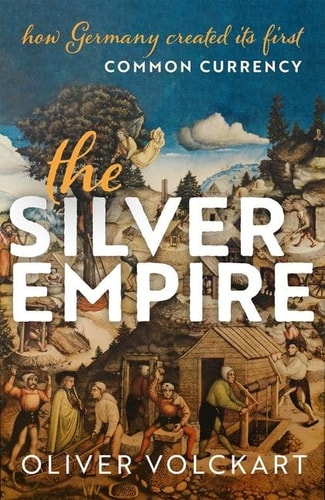
The Silver Empire: How Germany Created Its First Common Currency
0
0
As an Amazon Associate and affiliate partner, Menrva Books earns from qualifying purchases. Learn more
Author Description
The Silver Empire is the first comprehensive account of how the Holy Roman Empire created a common currency in the sixteenth century.The problems that gave rise to the widespread desire to introduce a common a currency were myriad. While trade was able to cope with-and even to benefit from-the parallel circulation of many different types of coin, it nevertheless harmed both the common people and the political authorities. The authorities in particular suffered from neighbours who used their comparatively good money as raw material to mint poor imitations. Debasing their own coinage provided an, at best, short-term solution. Over the medium and long term, it drove the members of the Empire into rounds of competitive debasements, until they realised that a common currency was the only answer that addressed the core of the problem.Oliver Volckart examines the conditions that shaped the monetary outlook of the member states of the Empire, paying particular attention to the uneven access to silver and gold. Following closely the negotiations that prepared the common currency, he is able to illuminate the interest groups that were formed, what their agendas and ulterior motives were, how alliances were forged, and how it was eventually possible to obtain majority agreement on what a common currency should look like: a silver-based currency that was introduced in 1559-66.In fact, in contrast to what historians once believed, the common currency they achieved turns out to have functioned not significantly worse than other currencies of the time: it had similar problems and similar advantages as the money issued by more centralized governments.
Menrva's Summary
THE THESIS
This book investigates the historical mechanisms and political negotiations that led the Holy Roman Empire to establish a unified currency during the sixteenth century. Oliver Volckart, an expert in economic history, utilizes archival records and monetary data to analyze the competitive debasement cycles that plagued German states. He argues that the eventual adoption of a silver-based currency in 1559-66 was a rational response to systemic economic instability rather than a failure of governance. The text provides a framework for understanding how fragmented political entities navigate complex financial integration.
THE SCOPE MAP
What You Will Find
- Analysis of the sixteenth-century Holy Roman Empire monetary landscape.
- Examination of competitive debasement and its impact on regional trade.
- Detailed account of the political negotiations and interest group dynamics behind the 1559-66 currency reform.
- Comparative assessment of the common currency against centralized monetary systems of the era.
THE AUTHORITY PERSPECTIVE
Experts recognize this work as a significant contribution to the economic history of the Holy Roman Empire, particularly for its focus on the intersection of political fragmentation and monetary policy. Readers frequently note the academic density of the prose, which provides a rigorous examination of historical financial systems.
Page Count:
384
Publication Date:
2024-01-01
Publisher:
Oxford University Press
ISBN-10:
0198894481
ISBN-13:
9780198894483
History
Economics
European History
Finance
Educational Resources
Europe
Germany
Community Tags
Other Editions(2)
Similar Books