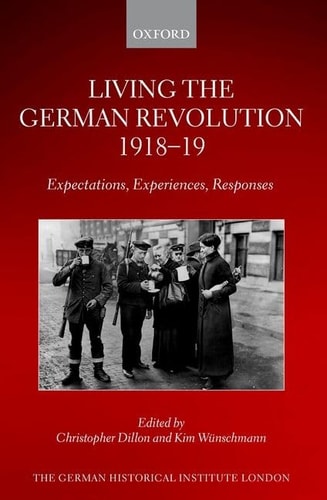
Living the German Revolution, 1918-19: Expectations, Experiences, Responses
0
0
As an Amazon Associate and affiliate partner, Menrva Books earns from qualifying purchases. Learn more
Author Description
The German Revolution of 1918-19 marks a historical turning point at which, following the catastrophe of the Great War, soldiers and civilians rose up to overthrow the German Empire's political and military leadership. The prospect of radical change evoked diverse hopes and fears in Germans young and old, female and male, rural and urban, Catholic, Protestant and Jewish. The essays in this volume, which are all based on fresh archival research, analyse their various expectations, experiences, and responses towards the revolution. Whereas much of the existing scholarship concentrates on the high politics and institutional contests of the revolution, these essays are concerned with revolutionary culture and subjectivities. They seek to historicize the revolution not so much from above, or from below, but from within, as a lived and open-ended civic experiment. This volume's cast of protagonists encompasses sailors mobilizing in north German naval bases, women storming town halls in provincial Bavaria, youngsters pounding Hamburg dance floors on wintery evenings, factory workers savouring the new eight-hour day, publishers grappling with shifting readerships, theologians debating constitutional arrangements, and journalists writing to make sense of a world seemingly turned upside down. The essays explore how the German Revolution unleashed the political imagination of a newly empowered citizenry. Their collective contention is that this socio-cultural approach best registers the revolution's popular mobilization and societal penetration, its destruction of inherited patterns of authority, and, ultimately, its complex and contested legacy for the Weimar republican project.
Menrva's Summary
THE THESIS
This volume investigates how the German Revolution of 1918-19 functioned as a lived, open-ended civic experiment that reshaped the political imagination of the German citizenry. Edited by Christopher Dillon, Kim Wünschmann, and others, the collection synthesizes fresh archival research to shift the focus from high-level institutional politics to the subjective experiences of individuals across diverse social, religious, and geographic backgrounds. The authors argue that a socio-cultural approach is necessary to understand the revolution's societal penetration and its subsequent impact on the Weimar Republic.
THE SCOPE MAP
What You Will Find
- Analysis of revolutionary culture and individual subjectivities during the 1918-19 transition.
- Case studies covering diverse demographics, including sailors, factory workers, women, and theologians.
- Examination of the destruction of inherited authority patterns and the emergence of new civic behaviors.
- Historical inquiry into the revolution's long-term legacy for the Weimar republican project.
THE AUTHORITY PERSPECTIVE
Scholars and historians recognize this collection as a significant contribution to the cultural history of the German Revolution. Readers frequently note the academic density of the prose and the value of the archival-based methodology in providing a nuanced view of the period.
Page Count:
380
Publication Date:
2024-01-01
Publisher:
Oxford University Press
ISBN-10:
0198898207
ISBN-13:
9780198898207
History
20th Century
Germany history
German history
Political History
Social History
European History
Community Tags
Similar Books