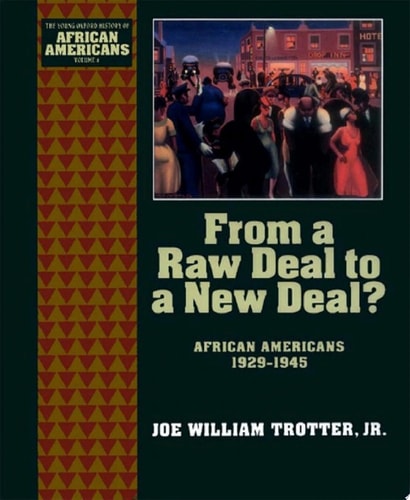
From a Raw Deal to a New Deal: African Americans 1929-1945
0
0
As an Amazon Associate and affiliate partner, Menrva Books earns from qualifying purchases. Learn more
Author Description
Bank closings, soup kitchens, bread lines, unemployed workers begging for work--these images defined the 1930s and '40s in America. For African Americans the era was a study in contrasts: black workers had the highest unemployment rate at a time when black leaders held important positions in Franklin Roosevelt's administration; New Deal legislation threw hundreds of thousands of black sharecroppers off the land while the same federal government provided unprecedented opportunities for black writers and artists; dramatic episodes of racist violence against African Americans occurred just as Communists and other radicals launched a nationwide campaign against racial injustice. When the United States entered World War II in 1941, the horrors of war provided an opportunity for blacks to demand equal treatment. As the African American servicemen, such as the all-black 99th fighter squadron (also known as the "Tuskegee Airmen"), fought for democracy overseas, black people at home were treated like second-class citizens. The war also created employment opportunities for many black working people. But few managed to get industrial jobs or into training programs, and those who did were likely to experience violent reprisals from disgruntled white workers. While U.S. troops invaded Normandy and bombed Okinawa, African Americans fought their own war at home. From a Raw Deal to a New Deal examines the impact of the depression and the war on black communities. The response of workers, farmers, activists, and the federal government, the inspiring cultural and intellectual achievements of such leading African Americans as Marcus Garvey, W. E. B. Du Bois, Langston Hughes, and Marian Anderson, and the role that war-time industrialization and recovery played in black protest movements paved the way for the modern civil rights movement. This is fascinating and relevant history for today's young people.
Menrva's Summary
THE THESIS
This volume investigates how the Great Depression and World War II functioned as catalysts for African American social, political, and economic transformation. Joe William Trotter Jr., a professor of history, utilizes archival records and historical analysis to argue that the era's contradictions—ranging from New Deal displacement to wartime industrial opportunities—forged the foundations of the modern civil rights movement. The text examines the interplay between federal policy, grassroots activism, and the intellectual contributions of prominent black leaders during this period.
THE SCOPE MAP
What You Will Find
- Analysis of the impact of the Great Depression on black sharecroppers and urban workers.
- Examination of the New Deal's contradictory effects on African American economic stability.
- Documentation of wartime industrialization and the emergence of the Tuskegee Airmen.
- Profiles of intellectual and cultural figures including W. E. B. Du Bois and Langston Hughes.
Scope Limits
- The text focuses primarily on the United States domestic experience between 1929 and 1945.
- It does not provide an exhaustive military history of World War II, focusing instead on the social implications for African Americans.
THE AUTHORITY PERSPECTIVE
This work is widely regarded as a foundational resource for students seeking to understand the socio-political climate of the mid-20th century. Readers frequently note that the prose is accessible yet rigorous, making it an effective educational tool for high school and undergraduate curricula.
Page Count:
128
Publication Date:
1996-01-01
Publisher:
Oxford University Press
ISBN-10:
0190282266
ISBN-13:
9780190282264
History
Minority Studies
United States
20th Century
History of the Americas
African American
Social History
Community Tags
Other Editions(2)
Similar Books
Reader Comments
Share Your Thoughts
No comments yet. Be the first to share your thoughts!