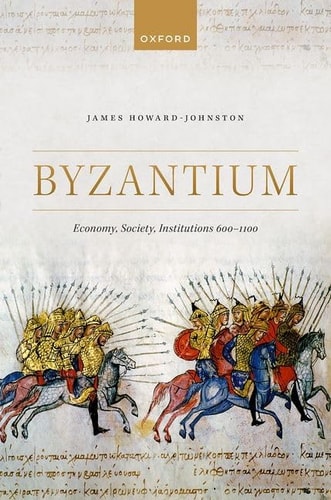
Byzantium: Economy, Society, Institutions 600-1100
0
0
As an Amazon Associate and affiliate partner, Menrva Books earns from qualifying purchases. Learn more
Author Description
Byzantium was a strange entity--a relic of classical antiquity which survived deep into the Middle Ages. Drawing on a lifetime's work in the field of Byzantine studies, James Howard-Johnston aims to explain Byzantium's longevity, first as a state geared to fighting a two-centuries long guerrilla war of defence, then as an increasingly confident regional power. It is only by analysing its economic, social, and institutional structures that this strange medieval afterlife of the rump of the Roman empire can be understood.This collection of linked essays outlines the fundamental features of Byzantium, with a focus on the seventh to eleventh centuries. The essays delve below the agitated surface of political, religious, and intellectual history to home in on (1) alterations in economic conditions; and (2) structural change in the social order and apparatus of government. The economic foundations of society and state are examined over the long term, with emphasis placed on mercantile enterprise throughout. Howard-Johnston identifies warfare as the prime driver of social and institutional change in a first phase (seventh to eighth centuries), when the peasant villager rose to a dominant position in the collective mindset and the administration was centralised and militarised as never before.A second phase of change is then highlighted, after the mid-ninth century when Byzantium's security was assured. Military and administrative arrangements were adapted as the empire expanded. The service aristocracy which had developed in the dark centuries began to assert itself to the detriment of the peasantry, but was, Howard-Johnston argues, countered reasonably effectively by new legislation. There was a renaissance in cultural life, most marked in the intellectual sphere in the eleventh century. Finally, the sharp decline in Byzantium's military fortunes from the mid-eleventh century is attributed to external factors rather than internal weakness.
Menrva's Summary
THE THESIS
How did the Byzantine Empire maintain its longevity and structural integrity as a medieval successor to the Roman state between the seventh and eleventh centuries? James Howard-Johnston, a veteran scholar of Byzantine studies, utilizes a collection of linked essays to examine the empire's economic, social, and institutional frameworks. He argues that the state's evolution was primarily driven by its military requirements, transitioning from a survivalist guerrilla-warfare posture to a confident regional power, while navigating the shifting tensions between the peasantry and the service aristocracy.
THE SCOPE MAP
What You Will Find
- Analysis of economic conditions and mercantile enterprise from the seventh to the eleventh centuries.
- Examination of structural changes within the social order and government administration.
- Investigation into the impact of prolonged warfare on state centralization and militarization.
- Evaluation of the legislative efforts to balance the influence of the service aristocracy against the peasantry.
THE AUTHORITY PERSPECTIVE
Scholars recognize this work as a significant contribution to the study of Byzantine institutional history, particularly for its focus on the long-term economic foundations of the empire. Readers frequently note the academic density of the prose, which provides a rigorous examination of the structural shifts that defined the medieval Roman state.
Page Count:
320
Publication Date:
2024-11-16
Publisher:
Oxford University Press
ISBN-10:
019889788X
ISBN-13:
9780198897880
History
Economics
Europe
Civilisation
Economic History
Byzantine History
Social History
Histoire
Community Tags
Similar Books