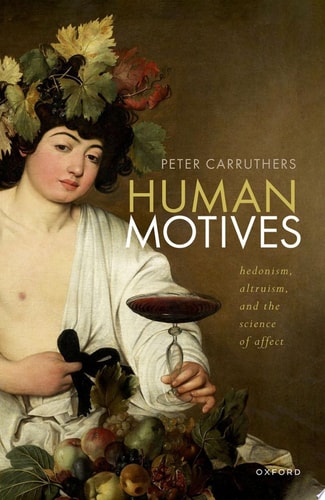
Human Motives: Hedonism, Altruism, and the Science of Affect
0
0
As an Amazon Associate and affiliate partner, Menrva Books earns from qualifying purchases. Learn more
Author Description
Motivational hedonism (often called “psychological hedonism”) claims that everything we do is done in pursuit of pleasure (in the widest sense) and to avoid pain and displeasure (again, in the widest sense). Although perennially attractive, many philosophers and experimental psychologists have claimed to refute it. Human Motives shows how decision-science and the recent science of affect can be used to construct a form of motivational hedonism that evades all previous critiques. On this view, we take decisions by anticipating and responding affectively to the alternatives, with the pleasure / displeasure component of affect constituting the common currency of decision-making. But we do not have to believe that the alternatives will bring us pleasure or displeasure in the future. Rather, those feelings get bound into and become parts of the future-directed representation of the options, rendering the latter attractive or repulsive. Much then depends on what pleasure and displeasure really are. If they are intrinsically good or bad properties of experience, for example, then motivational hedonism results. Carruthers argues, in contrast, that the best account is a representational one: pleasure represents its object (nonconceptually, in a perception-like manner) as good, and displeasure represents it (nonconceptually) as bad. The result is pluralism about human motivation, making room for both genuine altruism and intrinsic motives of duty.Clearly written and deeply scientifically informed, Human Motives has implications for many areas of philosophy and cognitive science, and will be of interest to anyone wanting to understand the foundations of human motivation.
Menrva's Summary
THE THESIS
This book investigates whether motivational hedonism can be reconciled with modern decision science and the science of affect to explain the full spectrum of human behavior. Peter Carruthers, a distinguished philosopher and cognitive scientist, synthesizes recent empirical findings to challenge traditional critiques of hedonism. He proposes a representational account of pleasure and displeasure, arguing that these affective states function as evaluative signals rather than mere sensations, thereby allowing for a pluralistic model of motivation that accommodates both altruism and duty.
THE SCOPE MAP
What You Will Find
- A critical analysis of psychological hedonism versus contemporary decision-making models.
- A representational theory of pleasure and displeasure as nonconceptual evaluations of goodness and badness.
- Integration of empirical data from cognitive science and affective neuroscience.
- A framework for understanding how altruistic and duty-based motives coexist with affective responses.
THE AUTHORITY PERSPECTIVE
Experts recognize this work as a significant contribution to the philosophy of mind and action, particularly for its attempt to bridge the gap between classical hedonistic theories and modern cognitive science. Readers frequently note the technical density of the prose, which requires a foundational understanding of both philosophical argumentation and psychological research methods.
Page Count:
240
Publication Date:
2024-01-01
Publisher:
Oxford University Press
ISBN-10:
0198906137
ISBN-13:
9780198906131
Psychology
Philosophy
Ethics
Decision Science
Community Tags
Similar Books