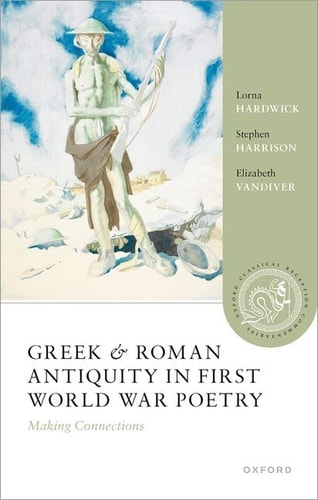
Greek and Roman Antiquity in First World War Poetry: Making Connections
0
0
As an Amazon Associate and affiliate partner, Menrva Books earns from qualifying purchases. Learn more
Author Description
Rupert Brooke, Wilfred Owen, Isaac Rosenberg, and Charles Sorley all died in the First Word War. They came from diverse social, educational, and cultural backgrounds, but for all of the writers, engagement with Greek and Roman antiquity was decisive in shaping their war poetry.The world views and cultural hinterlands of Brooke and Sorley were framed by the Greek and Latin texts they had studied at school, whereas for Owen, who struggled with Latin, classical texts were a part of his aspirational literary imagination. Rosenberg's education was limited but he encountered some Greek and Roman literature through translations, and through mediations in English literature.The various ways in which the poets engaged with classical literature are analysed in the commentaries, which are designed to be accessible to classicists and to users from other subject areas. The extensive range of connections made by the poets and by subsequent readers is explained in the Introduction to the volume.The commentaries illuminate relationships between the poems and attitudes to the war at the time, in the immediate post-war years, and subsequently. They also probe how individual poems reveal various facets of the poetry of unease, the poetry of survival, and the poetics of war and ecology.
Menrva's Summary
THE THESIS
How did the engagement with Greek and Roman antiquity fundamentally shape the thematic and stylistic development of First World War poetry? This volume, edited by Lorna Hardwick, Stephen J. Harrison, and Elizabeth Vandiver, examines the intellectual and cultural intersection between classical education and the traumatic reality of the Great War. The authors analyze how poets such as Rupert Brooke, Wilfred Owen, Isaac Rosenberg, and Charles Sorley utilized classical motifs to process their experiences, arguing that these ancient texts served as both a framework for understanding conflict and a tool for articulating the complexities of survival and loss.
THE SCOPE MAP
What You Will Find
- Comparative analysis of classical reception in the works of major WWI poets.
- Examination of how educational backgrounds influenced the use of Greek and Latin allusions.
- Detailed commentaries on specific poems linking them to classical literature and contemporary war attitudes.
- Exploration of thematic categories including the poetry of unease, survival, and war ecology.
THE AUTHORITY PERSPECTIVE
Experts identify this volume as a critical resource for understanding the intersection of classical reception and modern war literature. Readers frequently note the academic density of the prose, which serves as a foundational text for scholars interested in the cultural history of the early twentieth century.
Page Count:
272
Publication Date:
2024-01-01
Publisher:
Oxford University Press
ISBN-10:
0198907885
ISBN-13:
9780198907886
Poetry
History
Criticism & Theory
Literary Criticism
Community Tags
Similar Books