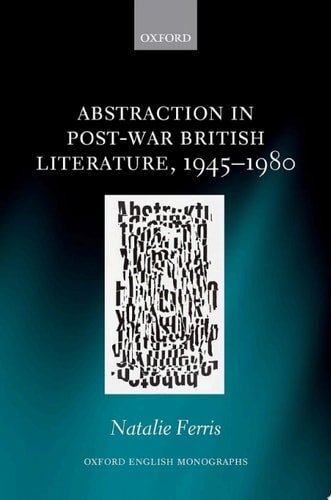
Abstraction in Post-War British Literature 1945-1980
0
0
As an Amazon Associate and affiliate partner, Menrva Books earns from qualifying purchases. Learn more
Author Description
In a catalogue note for the 1965 exhibition 'Between Poetry and Painting' at the Institute of Contemporary Arts, the poet Edwin Morgan probed the relationship between abstraction and literature: 'Abstract painting can often satisfy, but "abstract poetry" can only exist in inverted commas'. Language may be fragmented, rearranged, or distorted, abstract in so far as it is withdrawn from a particular system of knowledge, but Morgan was of the mind that to be wholly 'disruptive' was to deprive a poem of its 'point' as an 'object of contemplation'. Whilst abstract art may have come to fulfil or or fortify an impression of post-war taste, abstraction in literature continued to be treated with suspicion. But how does this speak to the extent to which Britain's literary culture was responsive to progress compared to its artistic culture? Abstraction in Post-War British Literature 1945-1980 traces a line of literary experimentation in post-war British literature that was prompted by the aesthetic, philosophical and theoretical demands of abstraction. Spanning the period 1945 to 1980, it observes the ways in which certain aesthetic advancements initiated new forms of literary expression to posit a new genealogy of interdisciplinary practice in Britain. At a time in which Britain became conscious of its evolving identity within an increasingly globalised context, this study accounts for the range of Continental and Transatlantic influences in order to more accurately locate the networks at play. Exploring the contributions made by individuals, such as Herbert Read, Ian Hamilton Finlay and Christine Brooke- Rose, as well as by groups of practitioners. It brings a wide range of previously unexplored archival material into the public domain and offers a comprehensive account of the evolving status of abstraction across cultural, institutional, and literary contexts.
Menrva's Summary
THE THESIS
This study investigates the extent to which post-war British literary culture engaged with the aesthetic, philosophical, and theoretical demands of abstraction between 1945 and 1980. Natalie Ferris, a scholar of modern literature, utilizes archival research and interdisciplinary analysis to challenge the historical perception that British literature remained resistant to the abstract movements that flourished in the visual arts. By examining the interplay between Continental, Transatlantic, and domestic influences, the author constructs a new genealogy of literary experimentation that reflects Britain's evolving cultural identity during this period.
THE SCOPE MAP
What You Will Find
- Analysis of literary figures including Herbert Read, Ian Hamilton Finlay, and Christine Brooke-Rose
- Examination of the relationship between visual art exhibitions and literary production
- Integration of previously unexplored archival materials
- A framework for understanding interdisciplinary practice in post-war Britain
Scope Limits
- The study is strictly bounded by the years 1945 to 1980
- It focuses primarily on the British literary response to abstraction rather than a comprehensive history of abstract art itself
THE AUTHORITY PERSPECTIVE
Scholars and critics recognize this work as a significant contribution to the study of post-war British aesthetics and interdisciplinary history. The text is noted for its rigorous archival research and its ability to bridge the gap between literary theory and art history.
Page Count:
192
Publication Date:
2022-01-01
Publisher:
OUP Oxford
ISBN-10:
0192594125
ISBN-13:
9780192594129
Interdisciplinary Studies
British literature
New Used & Rental Textbooks
Literary Criticism
Modernism
Criticism & Theory
Art History
English
English & College Success
Community Tags
Other Editions(2)

Similar Books


Reader Comments
Share Your Thoughts
No comments yet. Be the first to share your thoughts!