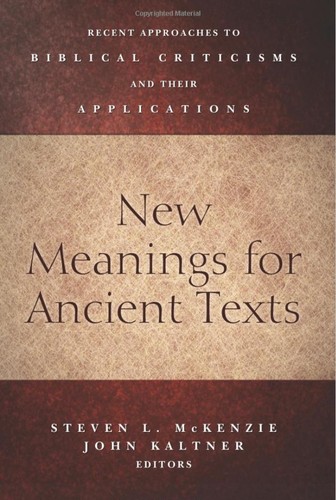
New Meanings for Ancient Texts
0
0
As an Amazon Associate and affiliate partner, Menrva Books earns from qualifying purchases. Learn more
Author Description
As newer approaches to biblical criticism become more established and influential, it is essential that students and other serious readers of the Bible be exposed to them and become familiar with them. That is the main impetus behind the present volume, which is offered as a textbook for those who wish to go further than the approaches covered in To Each Its Own Meaning by exploring more recent or experimental ways of reading. This book is a supplement and sequel to To Each Its Own Meaning, edited by Steven L. McKenzie and Stephen R. Haynes, which introduced the reader to the most important methods of biblical criticism and remains a widely used classroom textbook. This new volume explores recent developments in, and approaches to, biblical criticism since 1999. Leading contributors define and describe their approach for non-specialist readers, using examples from the Old and New Testament to help illustrate their discussion. Topics include cultural criticism, disability studies, queer criticism, postmodernism, ecological criticism, new historicism, popular culture, postcolonial criticism, and psychological criticism. Each section includes a list of key terms and definitions and suggestions for further reading.
Menrva's Summary
THE THESIS
This volume explores the evolution and application of contemporary biblical criticism since 1999. It serves as a supplement and sequel to the widely used textbook 'To Each Its Own Meaning,' delving into more recent and experimental methods of reading the Bible. Leading scholars introduce these approaches to non-specialist readers, illustrating their concepts with examples from both the Old and New Testaments. The book aims to equip students and serious readers with an understanding of these established and emerging critical perspectives.
THE SCOPE MAP
- Coverage of recent developments in biblical criticism since 1999.
- Definitions and descriptions of approaches such as cultural criticism, disability studies, queer criticism, postmodernism, ecological criticism, new historicism, popular culture, postcolonial criticism, and psychological criticism.
- Examples drawn from both the Old and New Testaments to illustrate critical methods.
- Key terms and definitions provided within each section.
- Suggestions for further reading to facilitate deeper exploration.
THE AUTHORITY PERSPECTIVE
This book is presented as an essential textbook for students and serious readers seeking to engage with contemporary methods of biblical criticism. It builds upon the foundation of a previously successful volume, offering a comprehensive overview of newer and experimental approaches. The inclusion of leading contributors defining their fields and providing scriptural examples suggests a text designed for clarity and accessibility to a non-specialist audience. The structure, including key terms and further reading suggestions, indicates a pedagogical focus aimed at facilitating academic study and deeper engagement with the subject matter.
Page Count:
196
Publication Date:
2013-01-01
ISBN-10:
0664238165
ISBN-13:
9780664238162
History
Non-Fiction
Religion
Literary Criticism
Community Tags
Similar Books