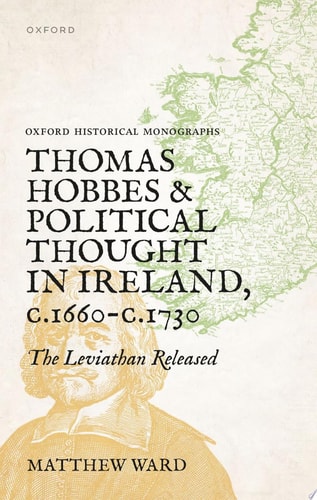
Thomas Hobbes and Political Thought in Ireland, c.1660-c.1730: The Leviathan Released
0
0
As an Amazon Associate and affiliate partner, Menrva Books earns from qualifying purchases. Learn more
Author Description
Thomas Hobbes and Political Thought in Ireland, c.1660-1730 is a history of political thought in Ireland, told from the perspective of the reception in that country of Thomas Hobbes, the English philosopher. Unlike Hobbes, political thought in Ireland has received little attention from historians: it is sometimes assumed that there is not much of a subject to study. The reception of Hobbes in Ireland forces us to challenge this assumption.To begin with, Matthew Ward highlights the variety and sophistication of political thought in Ireland. In his political thought, Hobbes was preoccupied by sovereignty, which he conceptualized in terms of natural law and made the defining characteristic of the commonwealth, or the 'Leviathan'; but he applied his concept of sovereignty to a broad range of political issues. His political thought was also part of a wider philosophical system which comprehended history, theology, natural philosophy, and mathematics. They may have been fewer than their counterparts in England, but Hobbes's readers in Ireland read him closely and compulsively. Indeed, they often fixated on his treatment of subjects, such as taxation, corporations, and the organization of empire, that were overlooked by his readers in England.The reception of Hobbes in Ireland also tells, therefore, of the distinctiveness of Ireland as a context of political thought. Hobbes's readers in Ireland were not only concerned with a distinctive selection of subjects; they also received Hobbes more positively than his readers in England. In England, Hobbes's concept of sovereignty was reviled for emasculating Parliament, the Anglican Church, and the common law. Too compelling to ignore, the 'Leviathan' had to be 'tamed'. In Ireland, where these institutions were weaker, the 'Leviathan' could be released.The key figures in the reception of Hobbes in Ireland in this period- Sir William Petty, John Vesey, and Edward Synge- were of different generations and political contexts. All thre
Menrva's Summary
THE THESIS
This work investigates the reception and application of Thomas Hobbes’s political philosophy within the specific socio-political context of Ireland between 1660 and 1730. Matthew Ward, a scholar of early modern intellectual history, utilizes a range of primary sources and historical records to challenge the assumption that Irish political thought during this period lacked sophistication or substance. By examining how Irish thinkers engaged with Hobbes’s concepts of sovereignty, natural law, and the commonwealth, the author demonstrates that Ireland served as a unique environment where Hobbesian ideas were received with greater openness than in England.
THE SCOPE MAP
What You Will Find
- An analysis of the intellectual climate in Ireland during the late seventeenth and early eighteenth centuries.
- A comparative study of how Hobbesian sovereignty was interpreted in Ireland versus England.
- Detailed examinations of key figures including Sir William Petty, John Vesey, and Edward Synge.
- Discussions on specific political issues such as taxation, corporate governance, and the organization of empire.
THE AUTHORITY PERSPECTIVE
Scholars recognize this monograph as a significant contribution to the study of Irish intellectual history, noting its success in shifting the focus toward previously overlooked regional political discourse. Readers frequently highlight the text's academic rigor and its ability to provide a nuanced understanding of how philosophical concepts are adapted to fit distinct institutional contexts.
Page Count:
304
Publication Date:
2024-01-01
Publisher:
Oxford University Press
ISBN-10:
0198904126
ISBN-13:
9780198904120
Philosophy
History
Irish History
Europe
Educational Resources
Intellectual History
Community Tags
Similar Books