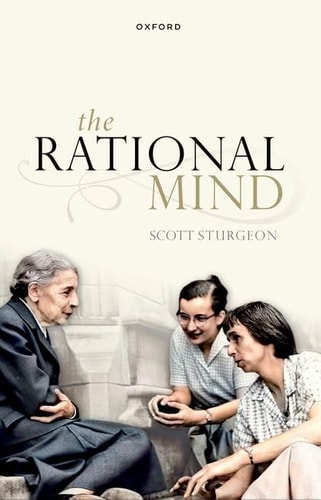
The Rational Mind
0
0
As an Amazon Associate and affiliate partner, Menrva Books earns from qualifying purchases. Learn more
Author Description
Scott Sturgeon presents an original account of mental states and their dynamics. He develops a detailed story of coarse- and fine-grained mental states, a novel perspective on how they fit together, an engaging theory of the rational transitions between them, and a fresh view of how formal methods can advance our understanding in this area. In doing so, he addresses a deep four-way divide in literature on epistemic rationality. Formal epistemology is done in specialized languages--often seeming a lot more like mathematics than Plato--and so can alienate philosophers who are drawn to more traditional work on thought experiments in epistemic rationality. Conversely, informal epistemology appears to be a lot more like Plato than mathematics and, as such, it tends to deter philosophers drawn to formal models of the phenomena. Similarly, the epistemology of coarse-grained states boils down everything to a discussion of rational belief--making the area appear a lot more like foundations of knowledge than anything useful for the theory rational decision, such as decision-making under uncertainty. The Rational Mind unifies work in all of these areas for the first time.
Menrva's Summary
THE THESIS
Scott Sturgeon investigates the fundamental divide between formal and informal approaches to epistemic rationality by proposing a unified framework for understanding mental states. The author, a philosopher specializing in epistemology, utilizes a synthesis of mathematical modeling and traditional thought experiments to bridge the gap between coarse-grained belief systems and fine-grained decision-making theories. By reconciling these disparate methodologies, the text provides a comprehensive architecture for analyzing how rational transitions occur within the human mind.
THE SCOPE MAP
What You Will Find
- A dual-layered model of mental states distinguishing between coarse-grained and fine-grained perspectives.
- A formal theory of rational transitions governing how beliefs and decisions evolve.
- A critical analysis of the four-way divide currently separating formal and informal epistemological literature.
- Methodological integration of mathematical formalisms with classical philosophical inquiry.
THE AUTHORITY PERSPECTIVE
Experts recognize this work as a significant attempt to synthesize competing schools of thought within contemporary epistemology. Readers frequently note the technical density of the prose, which requires a foundational understanding of both formal logic and traditional philosophical debate.
Page Count:
384
Publication Date:
2024-01-01
Publisher:
Oxford University Press
ISBN-10:
0198912250
ISBN-13:
9780198912255
Philosophy
Politics
Consciousness & Thought
Epistemology
Movements
Logic
Community Tags
Similar Books