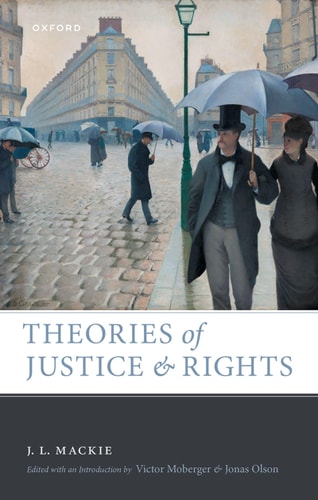
Theories of Justice and Rights
0
0
As an Amazon Associate and affiliate partner, Menrva Books earns from qualifying purchases. Learn more
Author Description
John Leslie Mackie (1917-1981) was one of the most influential philosophers of the twentieth century. His published works spanned many areas, but he is not well known as a political philosopher. In the late 1970s, however, Mackie turned his attention to issues concerning justice.In a series of writings, Mackie built a case for a unique right-based approach to political philosophy, in part by delivering incisive critiques of theories dominant at the time. His most comprehensive work in this area is Theories of Justice and Rights--a previously unpublished manuscript that finally sees the light of day in this volume. Also included are two of Mackie's previously published papers, written during the same period: 'Can There Be a Right-Based Moral Theory?' (1978) and 'Rights, Utility, and External Costs' (1985). Some of Mackie's arguments in these works draw on the metaethical conclusions in his seminal book Ethics: Inventing Right and Wrong (1977). The editorial introduction canvasses the initially puzzling relation between Mackie's moral error theory and his account of justice and rights, addresses some exegetical queries, and connects to present-day debates. In addition, the introduction provides summaries of Mackie's theory of rights, his critique of Rawls's liberalism, and of Nozick's libertarianism.
Menrva's Summary
THE THESIS
This volume investigates the viability of a rights-based approach to political philosophy by reconciling moral error theory with practical frameworks of justice. J. L. Mackie, a prominent twentieth-century philosopher, constructs this argument by critiquing the dominant liberal and libertarian theories of his time. The text synthesizes previously unpublished manuscripts with key essays to demonstrate how his metaethical skepticism informs a structured account of political rights and social obligations.
THE SCOPE MAP
What You Will Find
- A comprehensive critique of John Rawls's liberalism and Robert Nozick's libertarianism.
- An examination of the relationship between moral error theory and political rights.
- Analysis of utility and external costs in the context of rights-based moral theory.
- Editorial commentary connecting Mackie's historical arguments to contemporary philosophical debates.
THE AUTHORITY PERSPECTIVE
Experts identify this volume as a significant contribution to the understanding of Mackie's political thought, particularly for those familiar with his earlier work in metaethics. Readers frequently note the academic density of the prose, which requires a foundational knowledge of twentieth-century analytic philosophy to fully grasp the nuances of his arguments.
Page Count:
176
Publication Date:
2025-01-24
Publisher:
Oxford University Press
ISBN-10:
0198917406
ISBN-13:
9780198917403
Philosophy
Politics
Political Philosophy
Ethics & Morality
Ethics
Justice
Community Tags
Other Editions(2)

Similar Books