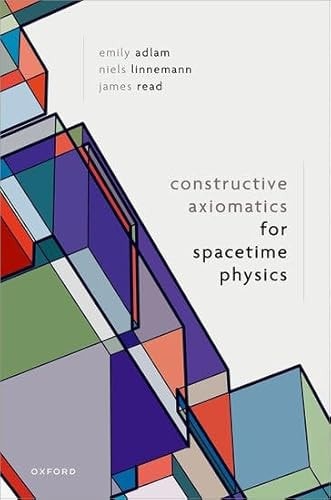
Constructive Axiomatics for Spacetime Physics
0
0
As an Amazon Associate and affiliate partner, Menrva Books earns from qualifying purchases. Learn more
Author Description
The programme of 'constructive axiomatics', promulgated by Hans Reichenbach in 1924, seeks to build up the architecture of our best theories of physics from basic axioms supposedly imbued with immediate and indubitable empirical content. Taking inspiration from Reichenbach, Hermann Weyl proposed his own 'causal-inertial' approach to the constructive axiomatisation of Einstein's general relativity, according to which a relativistic spacetime can be constructed solely from the trajectories of light rays and freely-falling particles; this project, however, came to fruition only in 1972, with the constructive axiomatisation of general relativity due to Ehlers, Pirani, and Schild ('EPS'). One century since Reichenbach, and fifty years since EPS, this book is a celebration of the constructive axiomatic methodology. It achieves four main tasks. First, it provides a thoroughgoing presentation of the EPS axiomatisation, closing missing loopholes, identifying problematic axioms, and so forth---in this way, one gains a much-improved appreciation of the extent to which a causal-inertial approach to general relativity might succeed, and of what such an approach might offer. Second, it synthesises and assesses the vast but disparate literature on constructive axiomatics which has arisen over the past century and sets the methodology in its proper philosophical context. Third, it generalises the approach to apply to quantum spacetimes. And fourth, it applies the approach to the context of non-relativistic spacetime physics. All in all, the book demonstrates that constructive axiomatics is live-and-kicking; the book will become the go-to resource for this way of philosophising about the nature of space and time.
Menrva's Summary
THE THESIS
This book investigates the viability and philosophical implications of the constructive axiomatic methodology in physics, specifically regarding the derivation of spacetime structures from empirical foundations. The authors, Emily Adlam, James S. Read, and Niels Linnemann, evaluate the historical trajectory of this approach, starting from Hans Reichenbach’s early 20th-century proposals through the Ehlers, Pirani, and Schild (EPS) framework. By synthesizing a century of literature, the authors argue for the continued relevance of constructive axiomatics in modern theoretical physics, extending its application to both quantum and non-relativistic domains.
THE SCOPE MAP
What You Will Find
- A rigorous technical analysis of the Ehlers, Pirani, and Schild (EPS) axiomatization of general relativity.
- A comprehensive historical and philosophical survey of the constructive axiomatic program since 1924.
- Methodological extensions of causal-inertial approaches to quantum gravity and non-relativistic spacetime models.
- Critical assessments of axiomatic loopholes and the empirical content of physical theories.
THE AUTHORITY PERSPECTIVE
Experts identify this work as a definitive resource for scholars interested in the intersection of mathematical physics and the philosophy of space and time. Readers frequently note the high level of technical and philosophical density, characterizing it as a foundational text for advanced researchers in the field.
Page Count:
224
Publication Date:
2025-07-21
Publisher:
Oxford University Press
ISBN-10:
019892237X
ISBN-13:
9780198922377
General Relativity
Philosophy history
Physics
SCIENCE Astronomy
Community Tags
Similar Books