
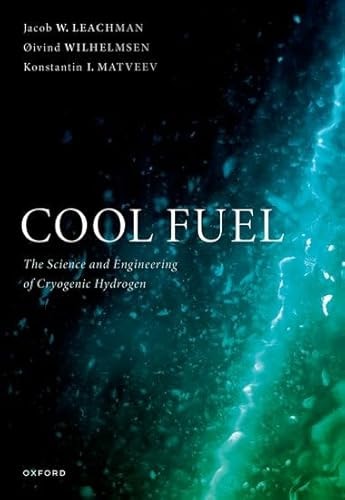
Cool Fuel: The Science And Engineering Of Cryogenic Hydrogen
0
0
As an Amazon Associate and affiliate partner, Menrva Books earns from qualifying purchases. Learn more
Author Description
Hydrogen, The First And Most Abundant Element In Our Universe, Is An Essential Zero-carbon Fuel In Humanity's Race Against Catastrophic Climate Change. However, Very Few Have Access To Cryogenic Systems For Energy-dense Hydrogen To Gain The Necessary Experience To Contribute To This Race. This Textbook Is Written As An Invitation For Scientists And Engineers With Experience In Thermodynamics, Fluid Mechanics, And Heat Transfer To Engage In This Race For The Future Via Cryogenic Hydrogen Research And Development. We Begin This Book With The History Of Hydrogen And Cryogenics To Create A Context For Current Needs. In Chapter 2, We Build A Foundation For Hydrogen's Unique Quantum Mechanical Effects On Bulk Thermophysical Properties, And How To Choose From And Utilize Available Property Models. Practical Methods Are Presented In Chapter 3 For Sensing And Converting Between The Quantum Mechanical Forms. Chapter 4 Presents Foundational Aspects Of Hydrogen Liquefaction And Cooling In Recuperative And Regenerative Cycles. Elements Of Hydrogen Transfer Phenomena Including Heat Exchanger Optimization And Recently Developed Two-phase Flow Correlations And Thermoacoustic Instabilities Are Discussed In Chapter 5. Chapter 6 Is An Extensive Analysis Of Liquid Hydrogen Storage System Options. The Final Chapter Of The Textbook Overviews The Cool Fuel School, A Hands-on Cryogenic Hydrogen Training Course That Helps Readers Develop A New System Design And Associated Cryogenic Hydrogen Safety Plan. Readers Of This Book Should Gain Confidence In The Foundational Aspects Of Cryogenic Hydrogen Science And Engineering-- Provided By Publisher.
Menrva's Summary
THE THESIS
This textbook investigates the fundamental scientific principles and engineering challenges required to utilize cryogenic hydrogen as a viable, zero-carbon fuel source for the future. The authors, Jacob W. Leachman, Konstantin I. Matveev, and Oivind Wilhelmsen, leverage their expertise in thermodynamics and fluid mechanics to provide a structured framework for researchers. By synthesizing historical context with modern property models and practical design methodologies, the text aims to equip engineers with the necessary knowledge to advance hydrogen research and development.
THE SCOPE MAP
What You Will Find
- Historical development of hydrogen and cryogenic technologies
- Analysis of quantum mechanical effects on bulk thermophysical properties
- Methodologies for hydrogen liquefaction, cooling cycles, and heat exchanger optimization
- Comprehensive evaluation of liquid hydrogen storage systems and safety protocols
THE AUTHORITY PERSPECTIVE
Experts identify this text as a specialized resource for professionals and students already grounded in thermodynamics and fluid mechanics. Readers frequently note the technical density of the prose, which serves as a foundational guide for those entering the field of cryogenic hydrogen research.
Page Count:
0
Publication Date:
2025-01-01
Publisher:
New York : Oxford University Press,
ISBN-10:
0198936680
ISBN-13:
9780198936688
Science
Thermodynamics
Energy
Engineering
Physics
Technology
Community Tags
Other Editions(2)
Similar Books













Reader Comments
Share Your Thoughts
No comments yet. Be the first to share your thoughts!