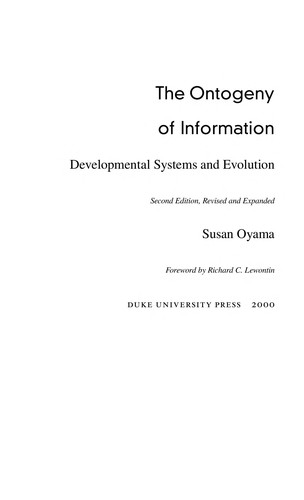
The Ontogeny of Information
0
0
As an Amazon Associate and affiliate partner, Menrva Books earns from qualifying purchases. Learn more
Author Description
The ontogeny of information challenges the traditional gene-centric view of development and evolution by proposing a more integrated model of how information is acquired and transmitted across generations. Susan Oyama's work critiques the concept of genetic determinism and the idea of a strict separation between nature and nurture, exploring the role of the environment and organismal behavior in shaping developmental trajectories and evolutionary change. The book examines the historical development of biological thought, tracing the origins of the nature-nurture dichotomy, and presents a framework for understanding information as a dynamic process involving interactions between genes, environment, and organism. It discusses the implications of this perspective for fields such as psychology, linguistics, and artificial intelligence, arguing for a more holistic and interactive understanding of biological inheritance and adaptation.
Menrva's Summary
THE THESIS
The Ontogeny of Information challenges the traditional gene-centric view of development and evolution by proposing a more integrated model of how information is acquired and transmitted across generations.
THE SCOPE MAP
- Critiques the concept of genetic determinism and the idea of a strict separation between nature and nurture.
- Explores the role of the environment and organismal behavior in shaping developmental trajectories and evolutionary change.
- Examines the historical development of biological thought, tracing the origins of the nature-nurture dichotomy.
- Presents a framework for understanding information as a dynamic process involving interactions between genes, environment, and organism.
- Discusses the implications of this perspective for fields such as psychology, linguistics, and artificial intelligence.
- Argues for a more holistic and interactive understanding of biological inheritance and adaptation.
THE AUTHORITY PERSPECTIVE
The book is recognized for its significant contribution to the nature-nurture debate, offering a sophisticated critique of genetic determinism. Scholars often cite Oyama's work as foundational for developmental systems theory, which emphasizes the dynamic interplay of multiple factors in development and evolution. The book is considered essential reading for those interested in the philosophy of biology and the complexities of inheritance. Its arguments continue to provoke discussion and shape research across various biological and psychological disciplines.
Page Count:
273
Publication Date:
2000-01-01
ISBN-10:
0822324318
ISBN-13:
9780822324317
Non-Fiction
Psychology
Science
Evolutionary Biology
Genetics
Developmental Biology
Community Tags
Similar Books