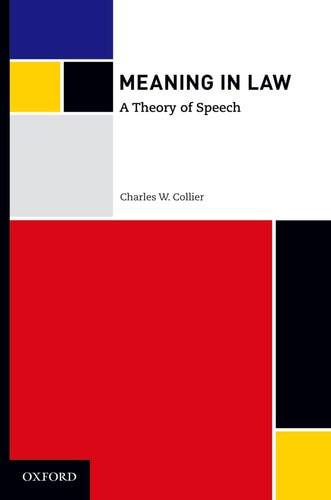
Meaning in Law: A Theory of Speech
0
0
As an Amazon Associate and affiliate partner, Menrva Books earns from qualifying purchases. Learn more
Author Description
Despite widespread admiration for the First Amendment's protection of speech, this iconic feature of American legal thought has never been adequately theorized. Existing theories of speech proceed on the basis of legal doctrine and judicial decisionmaking, social and political philosophy, or legal and intellectual history. But these are not the disciplines one would most naturally turn to in analyzing speech. Meaning in Law: A Theory of Speech takes a new and different approach. This book develops a general legal theory of speech on the basis of linguistic theory and thephilosophy of language.The opening chapters retrace the main conceptual stages in the expression of meaning: from natural meaning, through symbolism, to signification. Later chapters analyze symbolic speech (communication by nonlinguistic means) as the key to developing an intention-based theory of speech. The essential elements of the theory are (1) nonnatural meaning, (2) the signaling of intent, (3) the recognition of intent, and (4) establishing a convention.A final chapter applies these insights to the case law of symbolic speech and resolves some basic confusions in the legal literature. This analysis proceeds by way of an original distinction between actual conduct (in the real world) and the "ideal conduct" described in a statute. The former may be described both as communicative andnoncommunicative, while the latter has already been conceptualized as either communicative or noncommunicative. This distinction clears up a major legal quandary: how conduct that counts as communication may nevertheless be regulated or prohibited, without running afoul of the First Amendment's protection of speech.
Menrva's Summary
THE THESIS
This book investigates the lack of a robust theoretical foundation for the First Amendment's protection of speech by applying the principles of linguistic theory and the philosophy of language to legal doctrine. Charles W. Collier, a scholar of legal theory, argues that traditional approaches—relying solely on judicial precedent or political philosophy—are insufficient for understanding the nature of speech. He proposes an intention-based framework that centers on nonnatural meaning and the signaling of intent to provide a more coherent structure for legal analysis.
THE SCOPE MAP
What You Will Find
- A conceptual progression of meaning from natural expression to symbolism and signification.
- An intention-based theory of speech utilizing the four elements of nonnatural meaning, signaling, recognition, and convention.
- An original analytical distinction between actual conduct and ideal conduct as defined by statute.
- An application of linguistic theory to existing First Amendment case law regarding symbolic speech.
THE AUTHORITY PERSPECTIVE
Legal scholars and philosophers view this work as a specialized intervention into First Amendment jurisprudence that bridges the gap between analytic philosophy and legal practice. Readers frequently note the technical density of the prose, which requires a foundational understanding of both linguistic theory and constitutional law to fully grasp the author's arguments.
Page Count:
208
Publication Date:
2009-08-07
Publisher:
Oxford University Press
ISBN-10:
0195388976
ISBN-13:
9780195388978
Philosophy
Politics
Words Language & Grammar
Constitutional Law
Categories
Reference
Kindle Store
Semantics Law
Linguistics
Legal Theory
Kindle eBooks
Law
Law Philosophy
Community Tags
Other Editions(2)
Similar Books